
How Workplace Ecosystems Are Reshaping Corporate Real Estate
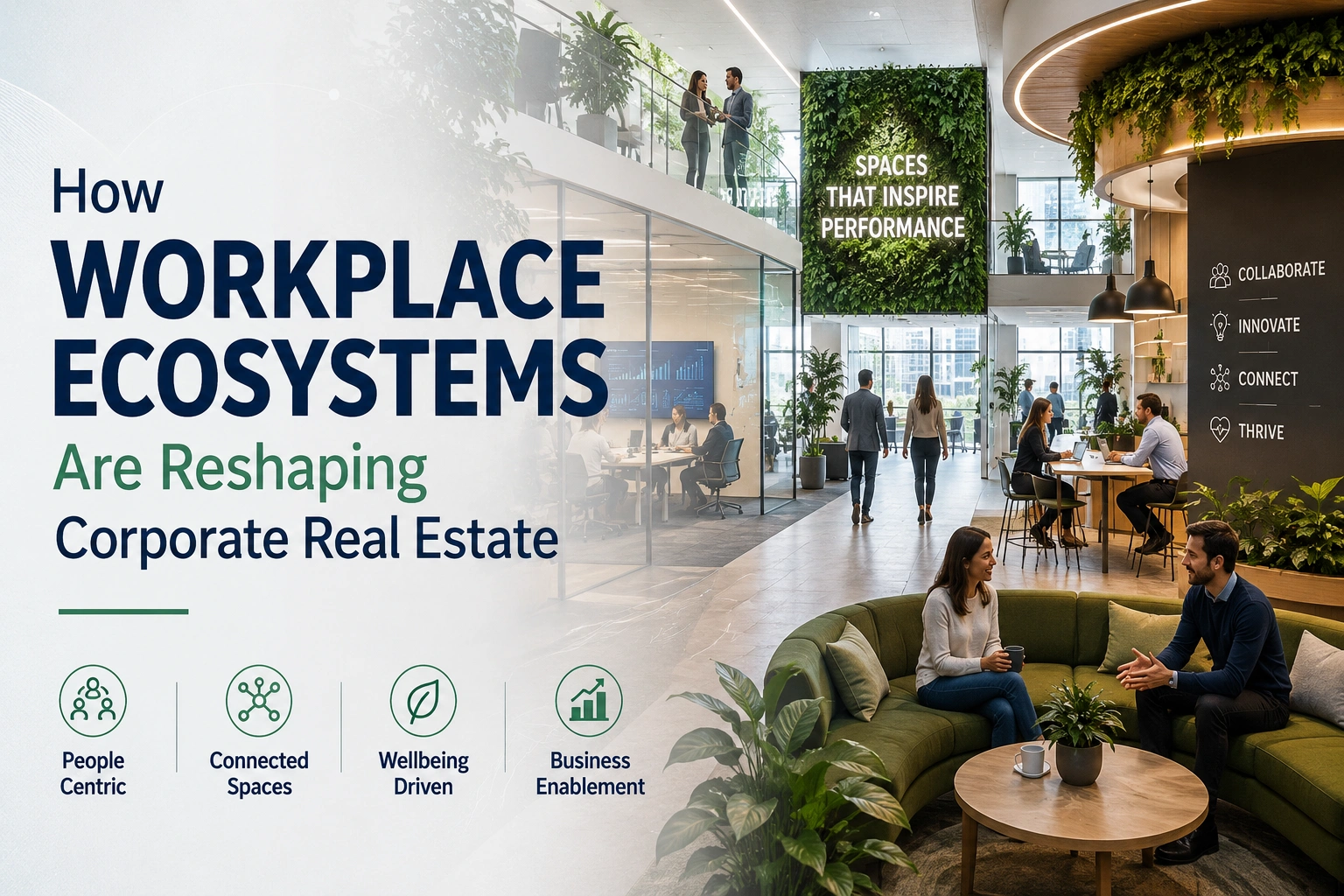
For decades, corporate real estate was largely a numbers game.
Organizations evaluated office space based on location, lease terms, occupancy costs, and utilization rates. Success was measured by square footage, rental efficiency, and portfolio size. The workplace itself was viewed as a business necessity rather than a strategic advantage.
Today, that mindset is rapidly changing.
As organizations navigate evolving workforce expectations, hybrid work models, technology-driven operations, and increasing pressure to remain agile, the role of the workplace has expanded significantly. Companies are no longer simply acquiring office space. They are building workplace ecosystems designed to support talent, collaboration, innovation, flexibility, and long-term business growth.
This shift is fundamentally reshaping enterprise and corporate real estate strategy.
Occupiers are rethinking portfolio structures. Landlords are enhancing workplace experiences. Developers are designing assets differently. Workspace providers are moving beyond space delivery to offer integrated business environments.
The conversation is no longer about how much office space a company needs.
The conversation is about how workplaces can create value.
What Is a Workplace Ecosystem?
A workplace ecosystem is an interconnected environment that combines physical space, technology, workplace services, employee experience, community, and operational flexibility into a unified workplace strategy.
Unlike traditional office models that focus primarily on real estate assets, the modern workplace model focuses on business outcomes.
These outcomes include:
- Talent attraction and retention
- Employee engagement
- Innovation and collaboration
- Operational agility
- Workplace productivity
- Organizational culture
The concept reflects a broader shift in how organizations think about the workplace.
Instead of viewing offices as standalone assets, businesses increasingly view them as part of a larger ecosystem that supports people, processes, technology, and business objectives.
Research from Deloitte highlights a similar evolution in workforce thinking, where organizations are increasingly managing interconnected ecosystems rather than isolated assets or functions. This ecosystem approach is influencing how businesses structure both their workforce and workplace strategies.
Traditional Enterprise Real Estate vs Workplace Ecosystems
| Traditional Enterprise Real Estate | Workplace Ecosystem Approach |
| Focus on space | Focus on outcomes |
| Lease-centric | Experience-centric |
| Cost optimization | Value creation |
| Fixed infrastructure | Flexible infrastructure |
| Occupancy metrics | Productivity and engagement metrics |
| Workplace as an asset | Workplace as a business enabler |
Why Are Companies Moving Toward Workplace Ecosystems?
The move toward the employee-centric workplace model is not being driven by workplace trends alone.
It is being driven by business priorities.
Three major shifts are forcing organizations to rethink Enterprise Real Estate.
1. Talent Has Become a Competitive Advantage
In today’s economy, attracting and retaining talent is often more important than reducing occupancy costs.
Employees increasingly evaluate workplaces based on:
- Flexibility
- Workplace experience
- Technology
- Wellness
- Collaboration opportunities
- Community
According to CBRE’s 2025 India Office Occupier Survey, 73% of companies identified workplace design and office experience as a key focus area for enhancing employee engagement and workplace effectiveness.
This signals a significant shift in corporate real estate thinking.
The workplace is no longer viewed solely as a cost center.
It is increasingly viewed as a talent strategy.
2. Businesses Need Greater Agility
Business cycles are becoming shorter.
Market conditions change faster.
Expansion plans evolve rapidly.
Workforce requirements fluctuate.
Traditional long-term real estate commitments often struggle to keep pace with these realities.
As a result, organizations are prioritizing:
- Flexible portfolio strategies
- Managed workspace solutions
- Scalable occupancy models
- Shorter decision cycles
Colliers’ 2026 Asia Pacific Workplace Insights report found that occupiers are actively reshaping workplace strategies around flexibility, workforce needs, and long-term adaptability. More than 800 occupiers across the region participated in the research.
This has accelerated the shift from static office portfolios to dynamic workplace environments.
3. The Purpose of the Office Has Changed
The office is no longer the default place where all work happens.
Instead, it has become a destination for activities that benefit from physical interaction, including:
- Collaboration
- Innovation
- Learning
- Culture-building
- Relationship development
CBRE’s Asia Pacific Office Occupier Survey found that organizations are increasingly prioritizing workplace experience as part of their return-to-office strategies. Nearly 300 enterprise real estate executives participated in the survey.
This means real estate decisions are now being influenced by experience, engagement, and productivity outcomes and not just occupancy metrics.
EFC’s Perspective: The Future Belongs to Workplace Ecosystems
The shift toward an employee-centric workplace model reflects a broader transformation in how businesses view the role of the workplace.
For years, corporate property portfolio decisions were primarily focused on securing space and managing costs. Today, organizations are increasingly evaluating how their workplaces contribute to business performance, talent attraction, operational agility, and employee experience.
At EFC, we believe this evolution will continue to accelerate.
As businesses navigate changing workforce expectations, expansion plans, and technology-driven operations, the workplace can no longer function as a static asset. It must become a dynamic ecosystem capable of supporting growth, collaboration, innovation, and flexibility.
This is particularly important in an environment where organizations need the ability to scale quickly, enter new markets efficiently, and adapt to evolving business requirements without being constrained by traditional real estate models.
The future workplace will not be defined solely by location or square footage. It will be defined by the value it creates for people and businesses.
This is why EFC focuses on creating workplace environments that combine infrastructure, flexibility, workplace experience, operational support, and business-ready ecosystems designed to help organizations perform at their best.
As workplace strategies continue to evolve, organizations that embrace ecosystem thinking will be better positioned to attract talent, foster innovation, and build resilient businesses for the future.
Conclusion
Corporate real estate is entering a new era.
The traditional approach of measuring success through occupancy rates, lease commitments, and square footage is gradually giving way to a more holistic view of workplace value. Organizations are increasingly recognizing that workplaces influence far more than operational efficiency; they shape employee experience, collaboration, innovation, culture, and business outcomes.
This shift is driving the rise of modern workplace models.
By integrating physical space, technology, workplace services, flexibility, and community, the employee-centric workplace model enables organizations to align their real estate strategies with broader business objectives. The workplace is no longer simply a place where work happens; it has become a strategic platform that supports growth and competitive advantage.
For occupiers, this means designing portfolios that prioritize agility and employee experience. For developers and landlords, it means creating environments that deliver value beyond physical infrastructure. For workspace providers, it means moving from a space-centric model to an outcome-driven approach.
As organizations continue to adapt to changing workforce dynamics and evolving business priorities, modern workplace models will play an increasingly important role in shaping the future of corporate real estate.
The question is no longer how much office space a company needs.
The question is whether its workplace ecosystem is helping it attract talent, support innovation, enable flexibility, and create long-term business value.
The organizations that answer that question effectively will define the next chapter of the corporate property portfolio.
Frequently Asked Questions (FAQs)
What is a workplace ecosystem?
A workplace ecosystem is an integrated environment that combines physical workspace, technology, workplace services, employee experience, and operational flexibility to support business objectives. Unlike traditional office models, modern workplace models focus on outcomes such as collaboration, productivity, innovation, and employee engagement.
How is a workplace ecosystem different from a traditional office?
Traditional offices primarily focus on providing physical space for employees to work. Workplace ecosystems take a broader approach by integrating workspace design, technology, workplace services, community, and flexibility to create an environment that supports both employee needs and business performance.
Why are companies moving toward workplace ecosystems?
Organizations are adopting workplace ecosystems to improve employee experience, attract and retain talent, enhance workplace flexibility, support hybrid work models, and align their real estate strategies with broader business goals. It helps organizations create more agile and productive work environments.
What role does technology play in the modern workplace?
Technology serves as a key component of the modern workplace by enabling workplace analytics, smart building management, digital collaboration, occupancy insights, and employee experience platforms. These tools help organizations make data-driven workplace decisions and optimize workplace performance.
How is the Employee-Centric Workplace Model influencing office leasing decisions?
Organizations are increasingly prioritizing flexibility in their leasing strategies. Rather than committing solely to traditional long-term leases, many occupiers are exploring managed workspaces, flexible office solutions, and hybrid portfolio models that support evolving business needs.
How can modern workplace models support business growth?
Modern workplace models support business growth by creating environments that enable collaboration, innovation, talent attraction, operational efficiency, and scalability. By aligning workplace investments with business objectives, organizations can improve performance and adapt more effectively to changing market conditions.
How is EFC helping organizations build workplace ecosystems?
EFC supports organizations through flexible workspace solutions, enterprise-ready infrastructure, strategic locations, and workplace environments designed to promote collaboration, agility, and employee experience. By enabling businesses to create a workplace ecosystem environment rather than simply occupying office space, EFC helps organizations align their workplace strategy with long-term business goals.
Sources
- CBRE 2025 India Office Occupier Survey
https://www.cbre.com/insights/reports/2025-india-office-occupier-survey - CBRE 2025 Asia Pacific Office Occupier Survey
https://www.cbre.com/insights/reports/2025-asia-pacific-office-occupier-survey - Deloitte Workforce Ecosystem Research
https://www.deloitte.com/us/en/insights/topics/talent/workforce-ecosystem-transformation-future.html - Colliers 2026 Asia Pacific Workplace Insights
https://www.colliers.com/en-in/news/asia-pacific-workplace-insights-2026