
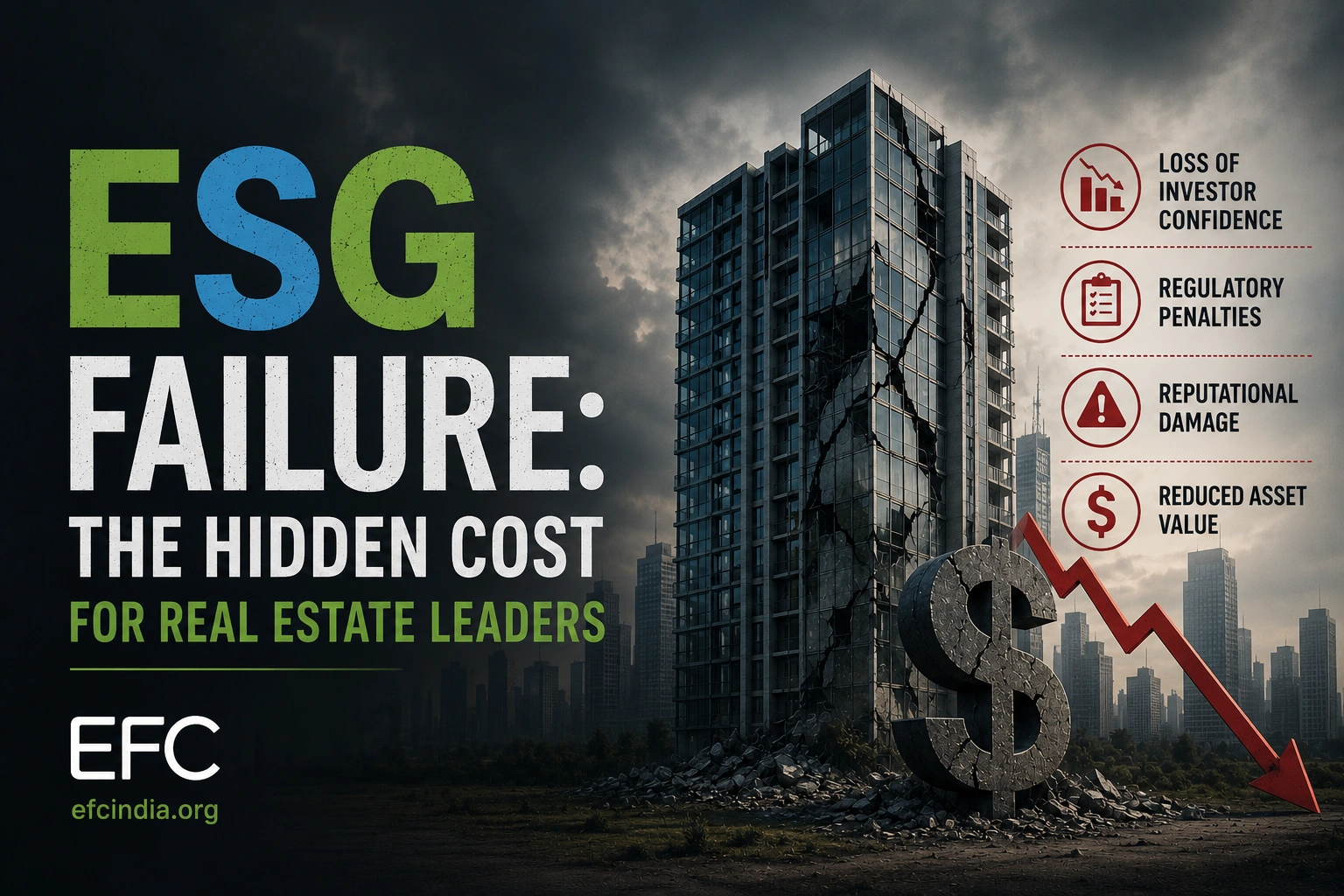
ESG Failure: The Hidden Cost for Real Estate Leaders
There is a quiet assumption still running through many corporate boardrooms in India: that ESG in real estate is something landlords worry about, not occupiers. The responsibility for green certification, energy performance, and sustainability compliance sits with the building owner, not the company leasing the floor.
That assumption is becoming expensive.
As regulatory frameworks tighten, investor expectations sharpen, and talent makes increasingly deliberate choices about where they want to work, the office a company chooses is no longer a neutral operational decision. It is a sustainability statement, and for a growing number of CXOs, it is turning into a compliance liability they did not see coming.
This blog is not about making the case for sustainability. That case has been made. This is about the specific, measurable costs of getting your corporate real estate strategy wrong in an ESG-driven market and why the window to course-correct is narrowing faster than most leaders realize.
What ESG in Real Estate Actually Means and Why It Is Different from General ESG
Most CXOs are familiar with ESG as a corporate governance framework, like disclosures, board diversity, emissions targets, and supply chain accountability. But ESG in real estate operates on a different and more immediate level. It is not just about what your company reports. It is about the physical environment your organization occupies and operates from every single day.
In a real estate context, ESG breaks down as follows:
Environmental refers to how a building performs against measurable sustainability criteria, such as energy efficiency, carbon emissions, water consumption, waste management, and indoor air quality. For corporate occupiers, this is the most consequential pillar because it directly feeds into Scope 1, 2, and 3 emissions reporting under frameworks like BRSR and GRI. A building’s energy rating is not the landlord’s problem alone; it becomes part of your organization’s environmental footprint the moment you sign a lease.
Social covers the quality of the workspace as it affects the people inside it, such as ventilation, natural light, thermal comfort, access to green spaces, and overall occupant wellbeing. Research consistently shows that buildings designed to WELL or IGBC standards report measurable improvements in employee productivity and reduction in absenteeism. For CXOs managing hybrid teams and competing for talent, this pillar connects directly to workforce performance.
Governance in a real estate context refers to the transparency and accountability structures around how a building is managed, whether the landlord or operator shares environmental performance data, tracks utility consumption at an asset level, and enables occupiers to meet their own reporting obligations. For companies with BRSR mandates, a building that cannot provide verifiable energy and emissions data is a governance gap in your sustainability disclosure.
Taken together, ESG in real estate means that your office address is no longer just a location decision. It is an environmental commitment, a talent signal, and a governance input — all at once. The organizations that understand this are making fundamentally different real estate decisions from those that still treat it as a facilities management issue.
The Regulatory Ground Has Shifted and Most CXOs Haven’t Caught Up
India’s ESG reporting landscape looked very different three years ago. BRSR was a new framework, assurance requirements were limited, and most companies treated sustainability disclosures as an extension of their CSR narrative.
That is no longer the case.
SEBI’s BRSR framework now mandates comprehensive ESG disclosures for India’s top 1,000 listed companies. The BRSR Core, introduced in 2023, requires independent third-party assurance on key performance indicators covering greenhouse gas emissions, energy consumption, water usage, and governance. Non-compliance carries penalties of ₹2,000 per day under SEBI’s LODR framework, with enforcement exposure reaching up to ₹1 crore.
From FY 2025-26, mandatory ESG reporting has expanded to the top 250 listed companies, including value chain disclosures. By FY 2026-27, assurance requirements extend further across the top 1,000 entities.
Here is where corporate real estate enters the picture. The buildings your organization occupies directly contribute to your Scope 1, 2, and 3 emissions. Energy consumption from office operations, HVAC systems and lighting, all of it flows into your BRSR disclosures. A company leasing space in a non-certified, energy-inefficient building is not just making a real estate decision. It is creating a reporting problem that will surface in its annual sustainability disclosures, in investor questionnaires, and increasingly, in procurement evaluations from clients with their own ESG mandates.
The Talent Cost Is Harder to Quantify and Therefore More Dangerous
Regulatory exposure is measurable. The talent cost of a poor office decision is more insidious; it does not appear in a penalty notice, but it compounds quietly over time.
A 2023 IBM study found that 71% of people are more likely to choose employers who visibly prioritize environmental responsibility. That number rises sharply among Gen Z and millennial professionals, the two cohorts that will define workforce composition in India’s knowledge economy over the next decade.
This is not an abstract preference. It is a recruitment and retention variable. When two comparable employers are competing for the same senior hire, and one operates out of a green-certified, thoughtfully designed workspace while the other occupies a conventional, non-certified building, the workspace signals something about organizational values that no employer branding campaign can easily override.
The office is physical proof of what a company believes. CXOs who treat it as purely a cost-per-seat calculation are leaving a talent signal on the table.
The Investor Scrutiny You May Not Have Accounted For
73% of global investors now evaluate companies on ESG metrics before committing capital, according to CrossVentura’s 2025 analysis of India’s BRSR landscape.
For listed Indian companies, this scrutiny is embedded into every major investment decision. Institutional investors, pension funds, sovereign wealth funds, and global asset managers are running ESG screens as standard protocol. A weak environmental disclosure, particularly one that reveals high energy consumption from non-certified office facilities, introduces a risk signal that informed investors will price in.
The mechanism is straightforward: companies with poor ESG performance face higher scrutiny during fundraising, tighter financing terms, and in some cases, outright exclusion from ESG-screened portfolios that now represent a significant share of global capital allocation.
This is not a future risk. It is a current market reality for any Indian listed company with international investors or global institutional shareholders.
What Non-ESG Office Space Is Actually Costing You — In Numbers
The financial case against non-green office occupancy is now well-documented.
Green-certified buildings in India deliver 30–50% energy savings over conventional, non-certified counterparts. Over a three to five-year lease term, that gap in operational efficiency compounds into a material cost differential, one that appears directly in facilities budgets and, increasingly, in ESG performance metrics.
Vacancy rates tell a similar story. Green-certified Grade A office buildings in India’s top seven cities average 14% vacancy, compared to 16.3% for non-certified buildings. The market is expressing a clear preference and organizations on the wrong side of that preference are paying a liquidity premium on exits and lease renewals.
And then there is the retrofit cost, the bill that arrives when a company eventually decides to upgrade its environmental footprint. Retrofitting a conventional office to meet ESG standards is expensive, disruptive, and rarely seamless. The organizations that chose green-certified spaces from the outset do not face this calculation. Those who delayed it do.
The GCC Benchmark Is Setting a Standard Domestic Companies Cannot Ignore
Perhaps the sharpest signal of where the corporate real estate market is heading comes from Global Capability Centres, which are the sophisticated, investor-scrutinized, globally benchmarked occupiers that are redefining Grade A office demand in India.
GCCs are projected to drive 30–35 million sq. ft. of office leasing in India in 2026 alone, accounting for 40–50% of all Grade A demand. Nearly 60% of GCC bases operating out of flex spaces now occupy green-certified, Grade A centres, because their global parent companies require it, their ESG frameworks mandate it, and their institutional investors expect nothing less.
For domestic enterprises and mid-sized corporates, this benchmark matters beyond aspiration. When your clients, your partners, and increasingly your talent pool are all operating out of ESG-aligned workspaces, the gap between your office standard and theirs becomes visible in pitch meetings, in due diligence processes, and in the quality of workplace experience you can offer prospective hires.
The GCC occupier is raising the floor. The question is whether your corporate real estate strategy is keeping pace.
The Window to Course-Correct Is Narrowing
Over 80% of new Grade A office supply coming into India’s top markets in 2026 is projected to be green-certified. Overall green penetration in India’s commercial office stock is expected to reach 70–75% at the national level within this cycle.
What this means in practice: the proportion of non-green, non-certified office space available for lease in India’s prime markets is shrinking. Companies that have not yet aligned their corporate real estate strategy with ESG standards will find themselves competing for a diminishing, less desirable inventory at a time when regulatory disclosure requirements are making that choice increasingly visible to investors and stakeholders.
The cost of waiting is not just financial. It is strategic. Every lease renewal cycle is an opportunity to course-correct. Every one that passes without an ESG-aligned decision is a compounding liability.
The EFC Perspective: The Lowest-Risk Office Decision a CXO Can Make Right Now
The evidence points in one clear direction. Choosing an ESG-aligned, green-certified flex workspace is no longer a premium option reserved for MNCs with global sustainability mandates. It is the most commercially rational, compliance-ready, and future-proof office decision available to corporate occupiers in India today.
Flex workspaces in green-certified Grade A buildings address each of the cost vectors described in this blog simultaneously. They bring BRSR-relevant energy and emissions data as part of their operational infrastructure. They deliver the workspace quality that talent increasingly expects. Their position occupies organizations favorably in investor ESG screenings. And they do all of this without the capital commitment, retrofit risk, or long-term exposure of a conventional lease.
India’s flex workspace market has expanded to 82.3 million sq. ft. across the top seven cities, with ESG-aligned Grade A centres as its fastest-growing segment. The organizations moving into this space are not doing so for optics. They are doing so because the math on compliance, on talent, on investor relations, and on operational costs has become impossible to ignore.
The question for CXOs is no longer whether ESG in real estate matters to your organization. It is whether your current office reflects that it does.
Conclusion
Corporate real estate used to be a relatively low-stakes operational decision: find a location, negotiate a lease, and move in. That era is over.
In 2026, the office a company occupies is a data point in its BRSR disclosures, a signal to prospective talent, a variable in investor ESG screens, and a reflection of organizational values that stakeholders at every level are now equipped to evaluate. Getting it wrong carries costs that are no longer hypothetical; they are regulatory, financial, reputational, and competitive.
The CXOs who recognize this earliest will not just avoid the costs outlined in this blog. They will convert their corporate real estate strategy into a genuine organizational advantage, attracting better talent, satisfying investor scrutiny, and operating from spaces that reflect the kind of company they are building.
Hybrid solved the flexibility problem. ESG in real estate is the next problem on the board’s agenda. The time to solve it is now.
Frequently Asked Questions
What does ESG in real estate mean for corporate occupiers?
For corporate occupiers, ESG in real estate means that the office space you lease directly affects your sustainability disclosures, energy reporting, and emissions data. It is not just a landlord’s concern, but the building you occupy contributes to your Scope 1, 2, and 3 emissions, which now form part of mandatory BRSR reporting for India’s top 1,000 listed companies.
How does office space affect BRSR compliance?
Your office building’s energy consumption, carbon emissions, and environmental performance feed directly into the environmental metrics you are required to disclose under SEBI’s BRSR framework. A non-certified, energy-inefficient building creates reporting gaps and performance weaknesses that are visible to investors and regulators reviewing your annual sustainability disclosures.
Is choosing a green office space more expensive?
Not when you account for the total cost of occupancy. Green-certified buildings deliver 30–50% energy savings over conventional offices, have lower vacancy rates, and eliminate the retrofit costs that companies in non-certified spaces eventually face. Over a three to five-year period, the financial argument for green-certified space is increasingly stronger than the argument against it.
What is the penalty for BRSR non-compliance in India?
Non-compliance with SEBI’s BRSR reporting requirements carries penalties of ₹2,000 per day under the LODR framework, with enforcement exposure reaching up to ₹1 crore. Beyond direct penalties, weak ESG disclosures expose companies to investor scrutiny, stock exchange queries, and reputational risk in capital markets.
Why are GCCs setting the standard for office ESG in India?
GCCs operate under global ESG frameworks mandated by their parent companies and institutional investors. Nearly 60% of GCCs in flex spaces now occupy green-certified, Grade A centres, not by preference, but by requirement. As GCCs account for 40–50% of Grade A office demand in India, their standards are effectively raising the baseline expectation for what a credible corporate workspace looks like.
How can flex workspaces help meet ESG goals?
Flex workspaces in green-certified buildings provide ESG-aligned infrastructure from day one, shared energy systems, certified environmental performance, and measurable emissions data, without the capital commitment or retrofit risk of a conventional lease. For companies looking to improve their ESG profile quickly and credibly, a quality flex workspace is often the most practical and immediate solution available.