
Managed Office Space Tier-2 India: A 2026 Growth Story
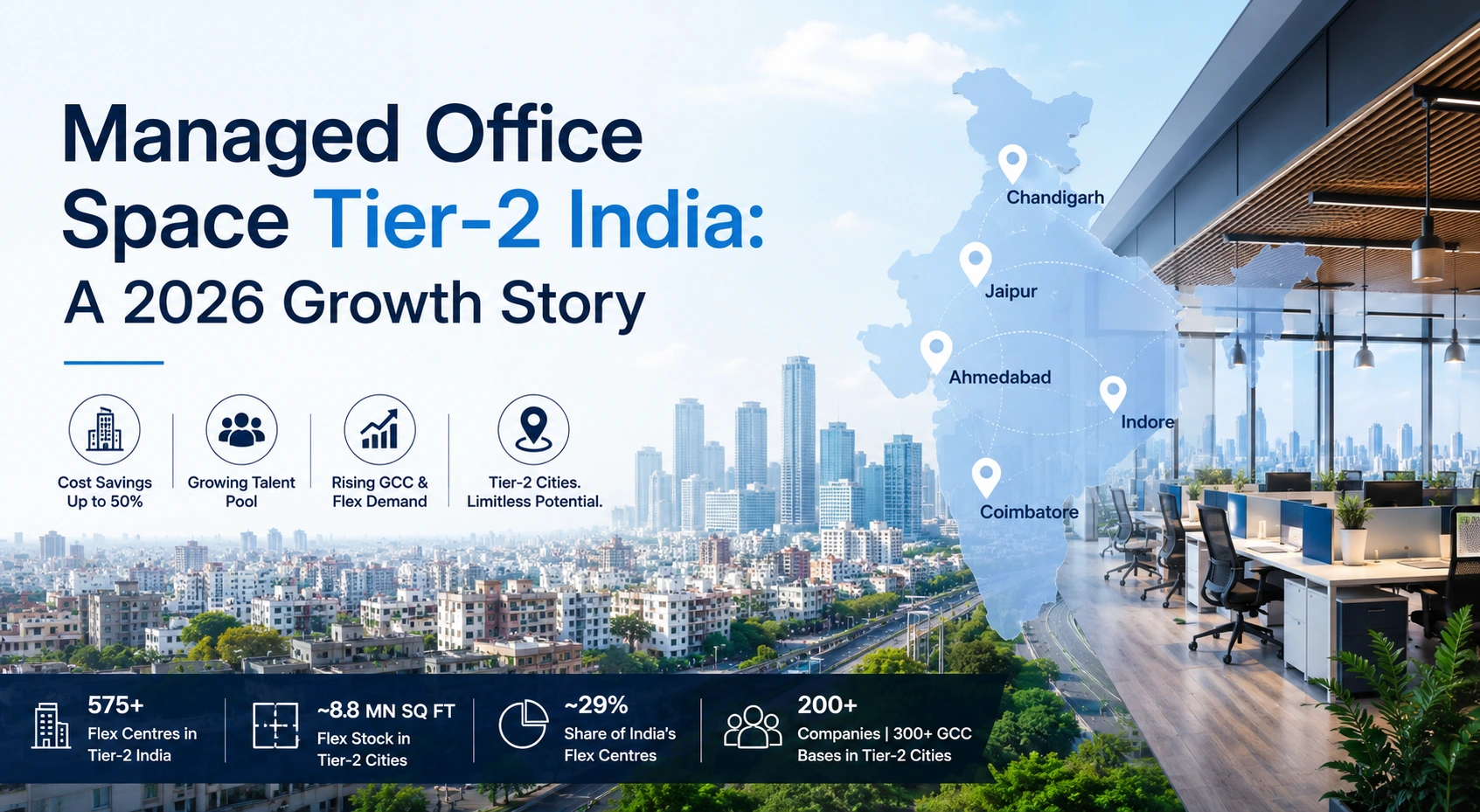
India’s office market is no longer a metro-only story. As Bengaluru, Hyderabad, and Mumbai push up against the limits of available Grade A stock and rising rentals, managed office space in Tier-2 India has quietly become one of the most consequential shifts in the country’s commercial real estate landscape. As of February 2026, Tier-2 cities host over 575 flex centres covering approximately 8.8 million sq ft, accounting for nearly 29% of India’s total flex centres and over 9% of the national flex stock. For an industry that was almost entirely metro-centric a decade ago, that is a structural shift, not a passing trend.
This piece unpacks what’s driving that shift, which cities are leading it, where the real risks lie, and why managed office operators, not just plug-and-play coworking brands, are best positioned to capture this next wave of demand.
The Data: Tier-2 Flex Office Space Growth in Numbers
The scale of India’s overall office market provides useful context. India’s office market recorded its strongest quarter on record in Q2 2026, with gross leasing touching an all-time high of around 24.6 million square feet, up 18% quarter-on-quarter and 14% year-on-year. Within that, flex office space has been one of the standout performers. Flex was the leading occupier segment for the second quarter in a row, with its share of Q4 2025 leasing hitting an all-time high of 26.6%. Colliers projects that annual leasing by flex office space operators will reach 15–18 million sq ft in 2026, accounting for 20–25% of overall leasing activity, with flex operators continuing to support GCCs through location advisory, compliance, and technology infrastructure support as they set up in India.
Tier-2 markets are capturing a meaningful and growing slice of this pie:
| Metric | Data Point |
| Tier-2 flex centres (Feb 2026) | 575+ centres, ~8.8 million sq ft |
| Share of India’s total flex centres | ~29% |
| Share of national flex stock | ~9% |
| Cost arbitrage vs. metro markets | Up to 50% savings |
| GCCs operating across Tier-2 cities | 200+ companies, 300+ GCC bases |
One of the biggest drivers behind this shift is cost arbitrage — flexible workspaces in Tier-2 cities offer savings of up to 50% compared to metro markets, making them attractive for both domestic firms and multinational corporations, a factor that has already driven significant traction from Global Capability Centres, with more than 200 companies setting up over 300 GCC bases across Tier-2 cities, primarily led by IT-ITeS, consulting, BFSI, and engineering. This is the clearest signal yet that Tier-2 India has moved from being a cost-saving afterthought to a genuine part of corporate real estate strategy.
Why Managed Offices Are Moving Beyond Metro Cities
Three structural forces are converging to make this shift durable rather than cyclical:
Cost arbitrage that’s too large to ignore. Operating costs in Tier-2 locations run 35–60% lower than Tier-1 hubs, depending on role mix and delivery model, while a broader analysis places overall living-cost reductions at 10–35% compared to the nearest Tier-1 counterpart. For occupiers running lean expansion plans, that’s a material difference on the balance sheet.
Talent that no longer wants to relocate. Around 11–15% of India’s technology talent already comes from Tier-2 cities, and a growing number of professionals are choosing not to relocate to metros, with companies reporting stronger retention in several Tier-2 locations, driven by lower living costs, shorter commutes, and a more stable base for the workforce. This reverses a decades-old migration pattern where graduates from smaller cities moved to Bengaluru or Hyderabad simply because that’s where the jobs were.
Infrastructure that’s finally catching up. Two of the top five cities in mobility infrastructure are Tier-2 cities — Bhubaneswar and Jaipur — with some Tier-2 cities showing better road infrastructure than a few Tier-1 cities, alongside rising scheduled domestic passenger traffic and a government-backed air connectivity push under the UDAN scheme. Digital infrastructure has closed the gap too: cloud adoption, fibre rollout, and hybrid work have removed the connectivity concerns that once made Tier-2 locations feel like a compromise for serious technology work.
State governments have also entered the picture directly. Maharashtra’s GCC Policy 2025 explicitly offers higher payroll subsidies and power tariff incentives to companies setting up outside the primary metro corridor, with Karnataka and Andhra Pradesh introducing similar frameworks. This is policy actively steering capital toward Tier-2 markets — not just organic demand finding its own level.
Which Tier-2 Cities Are Leading the Shift
Not all Tier-2 cities are playing the same role. A few clear specializations have emerged:
- Jaipur — emerging as a hub for back-office and customer support operations, backed by improving connectivity and a growing talent base.
- Coimbatore — evolving as a centre for manufacturing and tech-driven GCCs, building on its strong industrial base, and widely recognized as an emerging hub for GCCs given its strong engineering talent pipeline suited to product engineering and technical operations.
- Chandigarh — attracting IT and R&D investment on the strength of its high quality of life for a skilled workforce, with Chandigarh and neighbouring Mohali standing out for planned infrastructure and steady talent availability.
- Ahmedabad — expanding its footprint across finance, IT, and consulting, supported by the city’s entrepreneurial base.
- Indore — rising as a hub for IT and BPO operations, strategically located and increasingly favoured for analytics and shared services scale-up.
The pace of this shift is expected to accelerate. NASSCOM data points to a 30–40% rise in GCC demand from Tier-2 cities in the coming years, with Coimbatore, Indore, Jaipur, Nagpur, Bhubaneswar, and Chandigarh emerging as credible alternatives to traditional metro hubs. On the supply side, Chandigarh, Jaipur, Kochi, Ahmedabad, Lucknow, and Indore already have more than four flex operators active in each city — a meaningful density signal for occupiers evaluating whether a location has matured enough to support scaled operations.
Risks & Considerations for Tier-2 Expansion
The Tier-2 growth story is real, but it isn’t without friction, and occupiers evaluating a move need a clear-eyed view of the constraints.
Concentration hasn’t disappeared overnight. Roughly 95% of GCC operations remain concentrated in six major cities, according to India’s Ministry of Electronics and Information Technology, which is precisely why unlocking Tier-2 locations has become a deliberate policy and business priority rather than something happening on its own. Tier-2 markets are growing fast off a small base — the absolute scale still lags Tier-1 hubs considerably.
Grade A stock is uneven. While cities like Chandigarh, Jaipur, and Ahmedabad have more than four active flex operators each, other Tier-2 markets such as Bhubaneswar, Visakhapatnam, and Coimbatore have only a handful — meaning occupier choice, quality benchmarking, and negotiating leverage vary sharply from city to city. A blanket “Tier-2 strategy” that treats these markets as interchangeable will misjudge both cost and quality.
Senior talent and leadership depth remain thinner. Tier-2 cities are strong for engineering, back-office, and shared-services talent, but building senior, client-facing, or highly specialized leadership teams locally is still harder than in established metro ecosystems — which is why most mature GCCs keep core leadership functions anchored in Tier-1 hubs even as they expand delivery capacity into Tier-2 satellites.
Not every Tier-2 city is ready for every function. Cities are already specializing — Coimbatore for engineering, Jaipur for back-office and support, Chandigarh for IT/R&D — and occupiers who try to force a mismatched function into the wrong city (say, a high-touch client operations centre into a market built for engineering talent) will likely see the cost savings erode through inefficiency and attrition.
None of this undercuts the growth story — it simply means the winners in this next phase will be occupiers and managed office providers who treat city selection as a deliberate, function-by-function decision rather than a blanket cost play.
EFC’s Perspective: What This Means for Managed Office Providers
The data tells a consistent story: Tier-2 India isn’t a discount version of the metro playbook — it’s becoming a distinct layer of corporate real estate strategy in its own right. But there’s a nuance the market often misses. Cost arbitrage gets the headlines, yet the more durable driver is operational continuity: companies that build Tier-2 teams are finding lower attrition, faster onboarding into steady local talent pools, and fewer of the retention headaches that plague metro-based teams competing for the same senior candidates.
This is precisely where the managed office model has an edge over plain coworking. GCCs and mid-sized enterprises entering a new Tier-2 city typically don’t want to make a five-to-seven-year capex commitment before they’ve validated the location. What they need is a fully operational, compliance-ready office — fit-out, IT infrastructure, facilities management, and local regulatory handling — that can scale up or down as the mandate matures. A generic coworking desk doesn’t solve for that; a managed office does.
We also see this playing out in how mature GCCs are now structuring their real estate footprint — not as an all-or-nothing metro-versus-Tier-2 decision, but as a deliberate split, with core functions anchored in Tier-1 hubs and shared services, R&D extensions, and surge-hiring pods placed in Tier-2 satellites. For managed office operators, this means the opportunity isn’t just about opening more centres in Jaipur or Coimbatore — it’s about being the operational backbone that lets an enterprise treat Tier-2 India as a genuine extension of its Tier-1 strategy, not a separate, riskier bet.
Outlook: Tier-2 India Through 2030
The medium-term trajectory reinforces why this matters now rather than later. India is projected to host more than 2,400 GCCs by 2030, up from over 1,800 today, creating an estimated 2.8 million jobs — and Tier-2 cities are expected to absorb a disproportionate share of that next wave of expansion. NASSCOM’s projected 30–40% rise in Tier-2 GCC demand suggests these markets won’t just add incremental centres; they’ll meaningfully shift where India’s global capability ecosystem is built.
For managed office providers, this creates a narrow but valuable window. The state-level incentive programs emerging today — Maharashtra’s GCC Policy 2025, among them — are designed to compound over the next several years, meaning providers who establish credible, compliant, multi-city Tier-2 operations now will be better positioned than those who wait for demand to fully mature before entering. By 2030, the gap between “Tier-2 as an experiment” and “Tier-2 as core strategy” is likely to have closed entirely — and the providers who built operational depth early will be the ones enterprises default to when that shift completes.
Conclusion
Tier-2 India has moved past the experimental phase. The data — from flex stock growth to GCC expansion to state-level policy incentives — point to a market that is structurally, not temporarily, reshaping where Indian and global companies choose to build their operations. For managed office providers, this is less about chasing a trend and more about building the operational infrastructure that lets enterprises expand into these cities with the same confidence they’d have in a metro. The next few years will likely determine which providers become the default partner for that expansion — and which get left competing only in cities that are already crowded.
Frequently Asked Questions
- What is driving the growth of managed office space in Tier-2 India?
Cost arbitrage of up to 50% versus metro markets, a growing local talent pool that increasingly prefers not to relocate, improving physical and digital infrastructure, and active state government incentives are together driving the shift of managed office demand into Tier-2 cities. - Which Tier-2 cities are seeing the most managed office and GCC activity?
Jaipur, Coimbatore, Chandigarh, Ahmedabad, and Indore are among the most active, each developing distinct specializations — from back-office and customer support in Jaipur to manufacturing-linked GCCs in Coimbatore and IT/R&D in Chandigarh. - Is managed office space actually cheaper in Tier-2 cities than in metros?
Yes. Reported savings range from roughly 35–60% on operational costs and 10–35% on overall living costs compared to the nearest Tier-1 city, depending on the role mix and delivery model. - What are the biggest risks of expanding into Tier-2 cities too quickly?
Uneven Grade A stock quality across cities, thinner senior leadership talent pools, and function-city mismatches (placing the wrong type of operation in a city not suited for it) are the primary risks occupiers should plan around. - Is Tier-2 expansion replacing Tier-1 office demand in India?
No — it’s additive rather than substitutive. Most mature GCCs and enterprises are running a split footprint, keeping core functions in Tier-1 hubs like Bengaluru and Hyderabad while placing shared services, R&D extensions, and surge-hiring pods in Tier-2 satellite cities.
References
- The Flex Insights — Flex Offices Expand to Tier-2 Cities in India — https://theflexinsights.com/indias-flex-office-market-extends-to-tier-2-cities-amid-gcc-expansion-vestian-report/
- Colliers — India Office Market Demand Forecast 2026 — https://www.colliers.com/en-in/news/press-release-india-office-outlook-2026
- Colliers — 2026 India Office: Unlocking Agility, Vitality & Flight-to-Quality — https://www.colliers.com/en-in/research/2026-india-office_unlocking-agility-vitality-and-flight-to-quality
- JLL — India’s Office Market Defies Global Headwinds with Record-Breaking 21.5 Million Sq. Ft. Leased in Q1 2026 — https://www.jll.com/en-in/newsroom/india-s-office-market-defies-global-headwinds-with-record-breaking
- JLL — India Office Market Dynamics Q1 2026 — https://www.jll.com/en-in/insights/market-dynamics/india-office
- Business Standard — India’s Office Mkt Posts Record Quarterly Leasing on GCC, Flex Demand: CBRE — https://www.business-standard.com/industry/news/india-s-office-mkt-posts-record-quarterly-leasing-on-gcc-flex-demand-cbre-126070600781_1.html
- EY India — GCCs Moving to Tier-2 Cities for Talent — https://www.ey.com/en_in/insights/consulting/exploring-the-shift-gccs-moving-to-tier-2-cities-for-cost-and-talent-advantages
- Mondaq — Why Enterprises Are Looking Beyond Bengaluru and Hyderabad and Expanding GCCs to Tier 2 Cities — https://www.mondaq.com/india/corporate-and-company-law/1806476/why-enterprises-are-looking-beyond-bengaluru-and-hyderabad-and-expanding-gccs-to-tier-2-cities
- Nasscom Community — The Rise of GCCs in Emerging Indian Cities — https://community.nasscom.in/communities/global-capability-centers/rise-gccs-emerging-indian-cities
- TechGraph — The Rise of Tier-2 GCCs: How Digital Infrastructure Is Redefining India’s Technology Talent Map — https://techgraph.co/opinions/rise-of-tier-2-gcc-digital-infrastructure-redefining-india-tech-talent-map/
- Flexiple — Global Capability Centers in India (2026): City-Wise List & Insights — https://flexiple.com/global-capability-centers/list-of-global-capability-centers-in-india