
GCC Growth in India Is Rewriting the Rules of Managed Office Space for Corporates
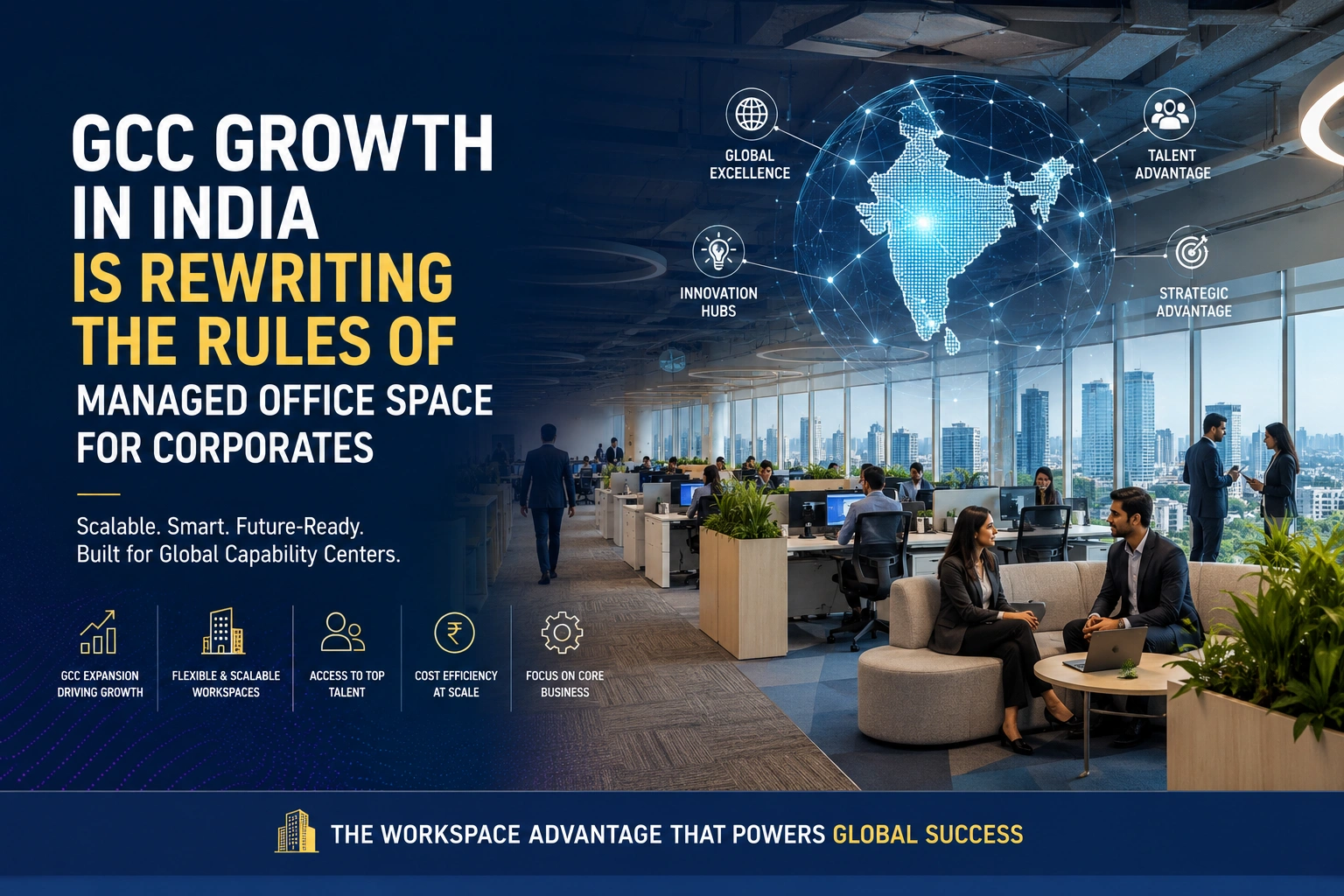
There is a number that quietly defines India’s commercial real estate market in 2026: 40–50%. That is the share of Grade A office leasing that Global Capability Centres are projected to account for this year, making GCCs the single largest occupier segment in the country. For any business involved in GCC office space India, whether setting up for the first time or scaling an existing operation, this shift has direct and immediate implications.
India is no longer simply a cost-efficient destination for offshore operations. It has become the world’s GCC capital, home to more than 1,760 centres employing nearly 1.9 million professionals, generating $64.6 billion in revenue in FY2024, and contributing over 1% of India’s GDP. And as GCCs continue to grow in scale, sophistication, and ambition, the way they approach managed office space for corporates is changing just as rapidly.
The GCC Explosion: Numbers That Define 2026
The scale of India’s GCC ecosystem is difficult to overstate. According to Colliers India’s 2026 office outlook report, “Unlocking Agility, Vitality and Flight-to-Quality”, GCC leasing volumes are expected to reach 30–35 million sq ft in 2026, accounting for 40–50% of all Grade A office demand across India’s top seven cities. (Source: Colliers India 2026 Office Report)
That follows a record-breaking 2025, in which GCCs accounted for 38% of office leasing across India’s major cities. The NASSCOM projection points forward with equal force: by 2030, India is expected to host 2,100–2,200 GCCs employing 2.5–2.8 million professionals, with revenues reaching $99–105 billion.
Around 110 new GCCs were set up in India between 2024 and 2025 alone, representing companies from the United States, Europe, the Middle East, and Southeast Asia, spanning sectors from financial services and pharmaceuticals to cybersecurity, AI research, and consumer technology. US-headquartered firms drive approximately 70% of all GCC demand. (Source: Wisemonk India Investment Intelligence 2026, via GCC Setup Guide)
The reason India commands this position is a combination of factors that no other market currently replicates: a talent pool of nearly two million GCC professionals with deep expertise across engineering, analytics, finance, and product development; cost structures running 30–50% below comparable operations in the US or Europe; a maturing regulatory environment; and a government at both the national and state level actively competing to attract GCC investment.
But talent and cost alone do not explain why India’s GCC ecosystem continues to accelerate. An equally important factor and one that is reshaping enterprise office space in India is the availability of world-class managed workspace infrastructure that allows companies to move fast.
Why GCCs Prefer Managed Office Space for Corporate
When a global company decides to establish or scale a GCC in India, the workspace decision is one of the most consequential it will make in the first ninety days. Get it wrong and the entire operation, that is talent hiring, IT setup, regulatory compliance, and go-live timeline, is delayed. Get it right and the GCC can be operational in thirty to sixty days.
The traditional approach, leasing space in a Grade A IT park, commissioning a fit-out, building out IT infrastructure, and establishing vendor contracts for facilities management, security, and housekeeping, takes nine to eighteen months and requires significant capital deployment before a single employee sits down. For a company establishing an India operation for the first time, that timeline and that capital exposure represent a substantial risk.
Managed office space for corporates eliminates most of that risk. A managed operator delivers a fully fitted, branded, enterprise-grade environment in a Grade A building, with IT infrastructure, dedicated fibre, on-site security, cafeteria, and facilities management included in a single monthly per-seat fee. The GCC team can be operational within thirty to ninety days of signing. Capital requirements have reduced from crores in security deposit and fit-out to a fraction of that.
The numbers at BMW Techworks India illustrate what this looks like in practice. The company scaled its Pune GCC from 100 seats to 700 in approximately 120 days, with a roadmap to 2,000 seats within twelve months, by using managed office infrastructure rather than building from scratch. (Source: TableSpace GCC Setup Guide)
This is not an outlier. L’Oréal established its first global beauty-tech GCC in Hyderabad, beginning with a 200-seat incubation space with plans to scale to 2,000 people. American Express set up a 12-month incubation centre in Chennai, designed and delivered in 90 to 120 days, purpose-built to support their transition to a long-term facility. In each case, the managed workspace decision was made early and treated as a strategic choice, not a logistics afterthought.
Flexible Office Space for Large Teams: The Hub-and-Spoke Model
GCCs in 2026 are not operating out of a single large campus. The most sophisticated are adopting what Colliers describes as a “distributed delivery hub” model: a flagship managed headquarters in a primary city, supported by satellite offices and flexible workspace nodes in secondary cities and emerging talent corridors. (Source: Colliers India Press Release, PR Newswire)
This hub-and-spoke approach serves multiple strategic objectives simultaneously. It allows a GCC to access talent pools that are not concentrated in a single city. It reduces operational risk by distributing headcount across multiple locations. It enables faster city-level expansion without committing to new long-term leases at each node. And it gives the GCC the ability to scale individual locations up or down based on hiring outcomes, which rarely follow projections exactly.
Flexible office space for large teams is the infrastructure that makes this model work. A managed headquarters provides the consistency, brand presence, and enterprise-grade environment that a GCC’s parent company expects. Flex nodes in secondary cities provide agility, the ability to establish a 50-seat presence in Coimbatore or Ahmedabad in four to six weeks, without a separate procurement cycle.
According to Cushman & Wakefield, nearly 50% of India’s total flex demand by 2027 is projected to come from GCCs. The managed office and enterprise model already accounts for 70–80% of all post-COVID flex demand. (Source: Cushman & Wakefield via The Realty Today)
The Cities GCCs Are Choosing and Why
City selection is among the most consequential decisions a GCC leadership team makes. Each major Indian market has a distinct specialisation profile, talent concentration, and cost structure.
Bengaluru leads India’s GCC ecosystem by a wide margin, with over 487 centres representing 33–40% of the country’s total GCC operations. It is the default destination for engineering, AI, product development, and innovation mandates. Flexible office stock in Bengaluru runs to 30–32 million sq ft, reflecting the depth of enterprise workspace infrastructure available.
Hyderabad has emerged as a strong second-tier alternative for GCCs in BFSI, analytics, pharmaceuticals, and AI. With over 273 GCC centres and real estate costs running 20–30% cheaper than Bengaluru, it offers compelling unit economics for large-team deployments. Microsoft’s 1,250-seat managed workspace in Hyderabad, delivered in 150 days to global design and compliance standards, is frequently cited as a benchmark for what is achievable at scale. (Source: TableSpace GCC City Analysis)
Pune has the highest flex penetration of any major Indian city, at 14–16% of total Grade A stock. The city’s concentration of automotive R&D, engineering firms, and manufacturing-adjacent operations makes it a natural GCC hub for companies whose India operations sit at the intersection of technology and physical industries.
Delhi-NCR and Chennai round out the top five. NCR is the preferred location for financial services, media, and consulting GCCs, with strong infrastructure in Gurugram’s Cyber City and Noida Expressway corridors. Chennai has a growing concentration of manufacturing, engineering, and analytics GCCs, supported by one of India’s most cost-competitive talent markets.
The emerging tier-2 story, cities like Coimbatore, Ahmedabad, Kochi, and Jaipur, is increasingly relevant for GCCs looking to expand beyond metro saturation. These cities offer 15–25% lower operational costs than tier-1 markets, with growing talent pools, lower attrition rates, and improving infrastructure. (Source: Wisemonk India Investment Intelligence 2026)
From Pilot to Scale: How GCCs Use Managed Offices at Every Stage
One of the underappreciated strengths of the managed office model is that it serves GCCs at every stage of their India journey, not just at inception.
At the pilot stage, a GCC of 50 to 150 seats needs to be operational quickly, without committing to infrastructure that it may not need at full scale. A plug-and-play office India solution is almost always the right answer here: a move-in-ready environment in a Grade A building, with all services bundled, in a location that gives the company immediate credibility with prospective hires. No fit-out risk, no vendor overhead, no eighteen-month distraction from the actual work of hiring and building the team.
As the GCC grows to 300 to 500 seats, the requirements shift. Brand consistency matters more. Data security protocols need to be more robust. The GCC’s parent company starts to have stronger opinions about design standards, employee experience, and sustainability credentials. A dedicated managed floor or multiple floors within a managed campus provides all of that, without the capital commitment of a wholly owned facility.
At the enterprise stage, a GCC of 1,000 seats or more often wants a branded, campus-style headquarters, a space that feels like the company’s own, reflects its global design standards, and serves as a talent magnet in a competitive hiring market. The best managed office providers deliver exactly this: a custom-designed, branded environment in a prime location, delivered to the client’s specification, with all operational services managed under a single contract.
This phased model, pilot in flex, grow in managed, anchor in branded campus, is how GCCs use flexible office space for large teams across the arc of their India expansion.
What GCCs Need from a Workspace Partner in 2026
As competition for GCC business has intensified among managed office operators, a clearer picture has emerged of what enterprise clients actually require, beyond the basics of square footage and price per seat.
Grade A buildings in established commercial districts are non-negotiable. A GCC in a peripheral location will struggle to attract senior talent, regardless of how well the interior is designed. The address matters.
Enterprise IT infrastructure is equally critical. Dedicated fibre with redundancy, 24/7 network operations support, enterprise-grade access control, CCTV coverage, and data room facilities are table stakes. GCCs handling regulated data, financial records, healthcare information, and proprietary IP cannot compromise on these.
Scalability on a single contract is highly valued. A managed operator that can take a GCC from 100 seats in Bengaluru to 500 seats across Bengaluru, Pune, and Hyderabad, under a single agreement, with consistent standards, removes enormous operational complexity from the GCC’s real estate team.
ESG compliance is increasingly mandatory, particularly for European and North American GCCs with parent-company sustainability reporting obligations. Green-certified buildings, energy monitoring, waste management protocols, and biophilic design are no longer premium differentiators. They are requirements. (Source: KAS Business Consulting GCC India 2026)
Finally, the hospitality-driven experience matters more than many operators acknowledge. Research cited in the JLL India GCC Guide 2026 indicates that 60% of GCC employees prefer premium, hospitality-style environments over purely functional workspaces. In a talent market where GCCs compete fiercely with one another and with Indian tech giants, the quality of the workspace is a hiring and retention tool, not just an operational backdrop. (Source: JLL India GCC Guide 2026)
India’s GCC Story Is Only Getting Started
The momentum behind India’s GCC sector in 2026 is structural, not cyclical. The factors driving it, talent depth, cost efficiency, government support, and improving infrastructure, are not short-term conditions. They are durable competitive advantages that other markets cannot replicate quickly.
The GCC office space India market will grow significantly from here. Colliers projects that India’s annual office leasing could reach 90–100 million sq ft in the coming years, with GCCs continuing to account for 40–50% of that demand. New entrants are arriving monthly. Established GCCs are expanding headcount and adding cities. (Source: Colliers India Office Forecast, via Business Standard)
For managed office operators, this is the most consequential growth opportunity in India’s commercial real estate history. For GCCs, it means that the quality and capability of workspace infrastructure have never been higher, and the case for getting workspace strategy right from day one has never been stronger.
Conclusion
The GCC boom is not a story about real estate. It is a story about how global companies are making their most important strategic bets on India and how the right managed office space for corporates is the foundation that makes those bets executable.
Whether you are setting up a 50-seat pilot in Hyderabad or scaling a 1,000-seat innovation hub in Bengaluru, the managed office model provides what no traditional lease can match: speed, consistency, scalability, and operational simplicity from day one. India’s GCC ecosystem will cross $100 billion by 2030. The companies that build on the right workspace foundation now will be best positioned to capture that opportunity.
FAQs related to How GCCs Are Rewriting India’s Office Demand
Q1. Why do GCCs prefer managed office space over traditional leases in India?
Speed and capital efficiency are the primary reasons. A managed office gets a GCC operational in 30–90 days with minimal upfront capital. A conventional build-out takes 9–18 months and requires significant fit-out investment before a single employee is hired. For companies entering India for the first time, that difference is strategically significant.
Q2. How large is India’s GCC sector in 2026, and why does it matter for office space?
India hosts over 1,760 GCCs employing 1.9 million professionals. GCCs are projected to account for 40–50% of all Grade A office leasing in 2026, making them the single largest occupier segment in the country. Every major managed office operator is now building a product specifically for GCC clients.
Q3. Which Indian cities are the top choices for GCC office space?
Bengaluru leads with 487+ GCC centres (33–40% of India’s total). Hyderabad is the second-largest hub, offering real estate 20–30% cheaper than Bengaluru. Pune has the highest flex penetration nationally and strong R&D and engineering GCC clusters. Delhi-NCR and Chennai are also significant, particularly for BFSI and manufacturing-adjacent GCCs.
Q4. Can a GCC start small in a managed office and scale up without relocating?
Yes, and this is one of the key advantages of the managed model. GCCs typically start with a 50–150 seat pilot, stabilise operations, then scale within the same managed ecosystem. BMW Techworks India grew from 100 to 700 seats in approximately 120 days using this approach, with no relocation disruption.
Q5. What should a GCC look for when choosing a managed office partner in India?
The five criteria that matter most are: Grade A buildings in established commercial corridors; enterprise-grade IT infrastructure with dedicated fibre and redundancy; multi-city network capability for consistent standards across Bengaluru, Pune, Hyderabad, and NCR; green-certified buildings for ESG compliance; and genuine scalability, the ability to add seats across cities under a single agreement without renegotiating from scratch.
Sources
- Colliers India 2026 India Office: Unlocking Agility, Vitality and Flight-to-Quality — https://www.colliers.com/en-in/research/2026-india-office_unlocking-agility-vitality-and-flight-to-quality
- Colliers India Press Release (PR Newswire, March 2026) — https://www.prnewswire.com/in/news-releases/india-office-market-stays-robust-demand-projected-at-70-75-million-sf-and-new-supply-likely-to-touch-60-65-million-sf-in-2026-colliers-302717165.html
- Colliers India Office Forecast via Business Standard — https://www.business-standard.com/content/press-releases-ani/india-office-market-stays-robust-demand-projected-at-70-75-million-sf-and-new-supply-likely-to-touch-60-65-million-sf-in-2026-colliers-126031900031_1.html
- Cushman & Wakefield Global Trends in Flexible Office 2025 via The Realty Today — https://therealtytoday.com/news/market-insights/indias-flexible-office-space-to-cross-100-million-sq-ft-by-2026-cushman-wakefield/
- Wisemonk India Investment Intelligence 2026 — https://www.wisemonk.io/global-capability-centers-in-india
- TableSpace GCC Setup in India — https://tablespace.com/gcc-setup-in-india/
- JLL India GCC Guide 2026 — https://www.jll.com/en-in/guides/gcc-office-guide
- KAS Business Consulting GCC India 2026 — https://kasbusinessconsulting.com/global-capability-centers-india-2026-new-gcc-launches/