
Green Managed Office Space India in 2026
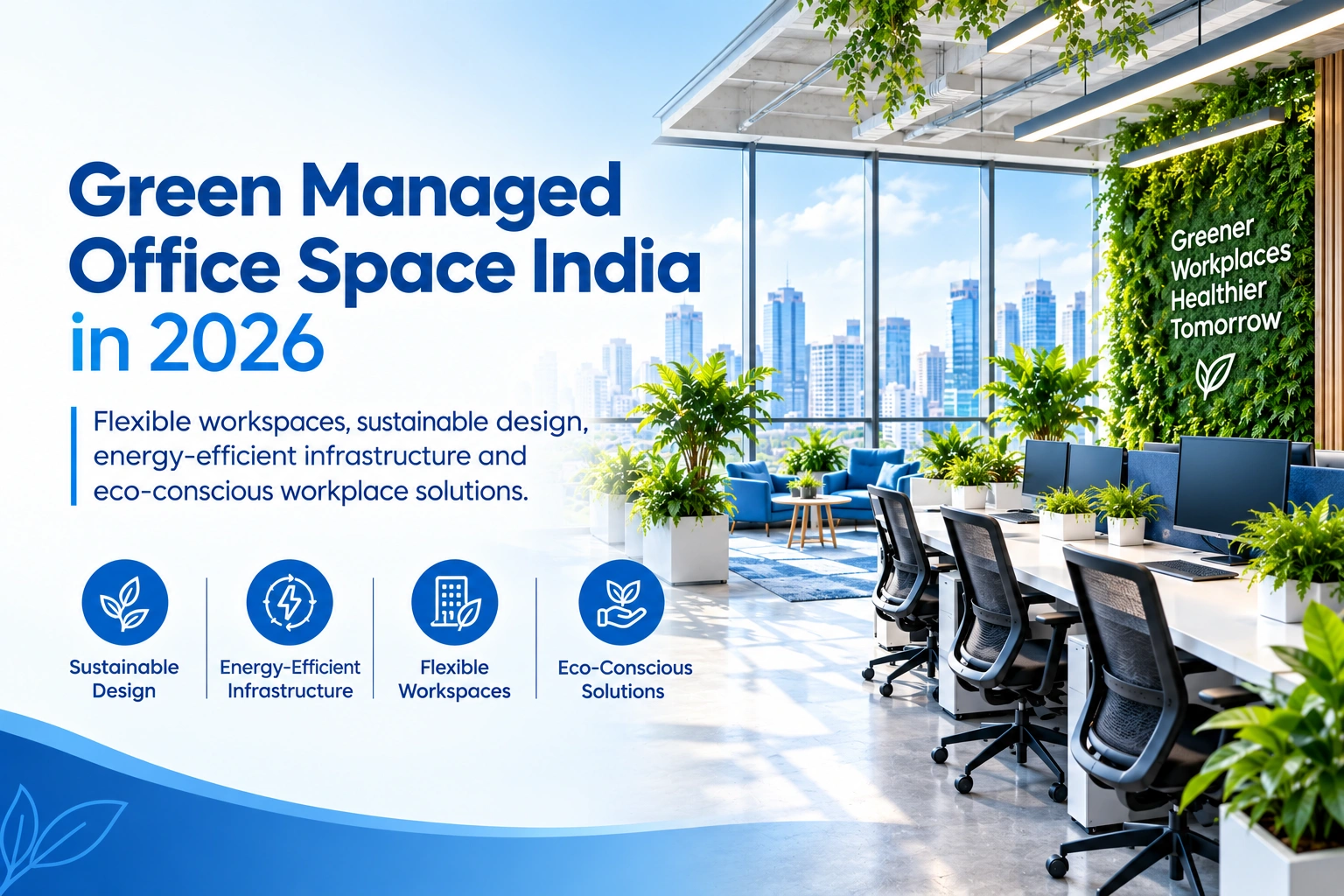
Green managed office space in India has moved from a differentiator to a baseline expectation. Indian occupiers are clearly shifting towards sustainability, with an evident flight-to-quality driving the next phase of workplace evolution in 2026 and beyond. With over 80% of upcoming Grade A supply expected to be green-certified, sustainability is no longer optional for enterprises choosing where to locate their teams.
This shift matters as much for managed office providers as it does for developers. As occupiers tighten their real estate criteria around certifications and energy performance, the operators who can offer genuinely sustainable, ESG-aligned workspace and not just a green building with a badge are the ones positioned to capture this next wave of demand.
The Data: India’s Green Office Market in 2026
The scale of this shift is now visible at the national level. As of 2025, with around 574 million sq. ft. of stock, green-certified buildings accounted for nearly two-thirds of India’s overall office stock, and going into 2026, over 80% of new supply is expected to be green-certified, pushing overall green penetration to 70–75% nationally. Leasing activity is following the same trajectory; activity in green-certified and tech-integrated buildings is set to rise and account for nearly 80% of overall leasing in 2026.
| Metric | Data Point |
| Green-certified share of existing stock (2025) | ~66% (of 574M sq. ft.) |
| Green-certified share of new supply (2026) | 80%+ |
| Overall green penetration, India (2026) | 70–75% |
| Green-certified building share of leasing (2026) | ~80% |
| Rental premium for LEED/IGBC-certified buildings | 8–15% over non-certified |
This isn’t a niche premium segment anymore. LEED/IGBC-certified buildings command rental premiums of 8–15% over non-certified properties, and occupiers with ESG reporting obligations are actively selecting certified buildings to simplify emissions reporting to parent companies and investors. Sustainability has effectively become a pricing and eligibility filter, not just a marketing claim.
Why Enterprises Are Prioritizing Green Office Space
Three forces are pushing sustainability from “nice to have” to “non-negotiable” in occupier decision-making:
Regulatory and investor pressure.
Retrofitting, renewable energy integration, and ESG-aligned design are becoming central to asset competitiveness, driven by global mandates, investor scrutiny, and occupier commitment to net-zero goals. For multinational occupiers and GCCs, a green-certified Indian office directly supports Scope 3 emissions reporting back to global headquarters.
Employee expectations tied to talent retention.
A 2024 CBRE survey found that office quality influenced job acceptance or retention decisions for 58% of employees across India’s top six cities, rising to 71% among technology workers, the most in-demand talent segment. In a hybrid-work environment where companies are actively trying to draw people back into the office, workplace quality has become a genuine retention lever, not just an aesthetic choice.
Institutional capital chasing climate-ready assets.
Climate-ready assets are likely to dominate institutional portfolios and REIT pipelines over the long term, with ESG commitments accelerating adoption of global best practices, meaning green buildings aren’t just easier to lease; they’re increasingly easier to finance and hold as investable assets.
Understanding the Certifications: LEED, IGBC, and GRIHA
Not all green certifications carry equal weight, and enterprises evaluating office space benefit from knowing the difference:
- LEED — the world’s most widely recognized system, developed by the U.S. Green Building Council and administered in India through GBCI with IGBC as local facilitator; best suited for Grade A commercial offices targeting global investors and international tenants, and India ranks among the top three countries globally for LEED-certified space.
- IGBC — India’s most commercially active rating body, offering more than 20 building-type-specific rating systems calibrated to Indian climate conditions, with state-level incentives including FAR benefits and tax rebates.
- GRIHA — India’s national rating system developed by TERI and endorsed by the Ministry of New and Renewable Energy, mandatory for central government buildings, with the strongest emphasis on passive design and lifecycle performance.
For enterprises, the practical guidance is straightforward: LEED signals international credibility for MNC tenants and global ESG investors, while IGBC is often the stronger fit where state incentives and Indian climate calibration matter more than global brand positioning.
EFC’s Perspective: Sustainability as a Core Part of Managed Office Delivery
For managed office providers, this shift changes what “enterprise-ready” actually means. It’s no longer enough to offer a fitted-out floor in a Grade A building; enterprises are now evaluating whether that building’s certifications, energy performance, and ESG credentials will hold up against their own reporting obligations and employee expectations.
At EFC, this is precisely where the managed model has an advantage over a generic lease. Enterprises don’t need to independently verify certification paperwork, negotiate green-building compliance clauses, or manage energy performance reporting; a managed office provider operating out of certified, climate-ready buildings absorbs that complexity on the occupier’s behalf. As green penetration crosses 70–75% of national office stock, the providers who actively prioritize certified buildings across their portfolio, rather than treating sustainability as a single flagship location, will be the ones enterprises default to when ESG becomes a hard filter rather than a soft preference.
This also reflects where the broader market is heading. Buildings without recognized green credentials are increasingly removed from consideration before site visits even begin — a pattern that will only intensify as more occupiers formalize sustainability requirements into their real estate procurement criteria.
Conclusion
Green managed office space in India has crossed a threshold: sustainability is no longer a differentiator that helps a building stand out; it’s rapidly becoming the baseline requirement for serious enterprise and GCC occupiers. With green penetration set to reach 70–75% nationally in 2026 and certified buildings already commanding measurable rental premiums, the market has made its preference clear. For managed office providers, aligning delivery around certified, energy-efficient buildings isn’t just good ESG positioning; it’s becoming a core condition for staying relevant to the enterprises driving India’s office demand.
Frequently Asked Questions
- What does “green managed office space” mean in India?
It refers to managed office space delivered within buildings certified under recognized green building standards, primarily LEED, IGBC, or GRIHA, that meet defined benchmarks for energy efficiency, water usage, indoor air quality, and sustainable materials. - What’s the difference between LEED, IGBC, and GRIHA certification?
LEED is a globally recognized standard best suited for enterprises targeting international credibility and MNC tenants; IGBC is India’s most commercially active certification, calibrated to Indian climate conditions with added state incentives; GRIHA is India’s national rating system with a strong focus on passive design, and is mandatory for central government buildings. - Do green-certified offices cost more to lease?
Yes. LEED/IGBC-certified buildings typically command rental premiums of 8–15% over non-certified properties, reflecting both higher build quality and stronger occupier demand for certified space. - Why are enterprises prioritizing green office space now?
Regulatory and investor pressure around ESG reporting, employee expectations around workplace quality (especially among technology talent), and institutional capital increasingly favoring climate-ready assets are together pushing green certification from optional to essential. - How does a managed office provider make sustainability easier for enterprises?
A managed provider operating out of certified buildings absorbs the complexity of verifying green compliance, managing energy performance reporting, and meeting ESG procurement criteria, reducing the diligence burden on the enterprise itself.
References
- Colliers — India Workplace Revolution 2026: Flex & ESG Focus — https://www.colliers.com/en-in/news/press-release-2026-workplace-insights-report
- Colliers — 2026 India Office: Unlocking Agility, Vitality & Flight-to-Quality — https://www.colliers.com/en-in/research/2026-india-office_unlocking-agility-vitality-and-flight-to-quality
- The Realty Today — India’s Office Market Set for Strong Growth with 70–75 Million Sq Ft Demand in 2026: Colliers — https://therealtytoday.com/news/market-insights/indias-office-market-set-for-strong-growth-with-7075-million-sq-ft-demand-in-2026-colliers/
- Beacon Filing — India Commercial Real Estate Trends 2026 — https://beaconfiling.com/blog/india-real-estate-market-trends-commercial
- Max Estates — Nature Meets Work: The Sustainable Office Space — https://maxestates.in/sustainable-offices-in-delhincr-india
- DesignDrafter — LEED, IGBC & GRIHA: Green Building Certification Guide 2026 — https://designdrafter.com/green-building-certification-guide/