
Why the GCC Model Is No Longer Just for Large Enterprises
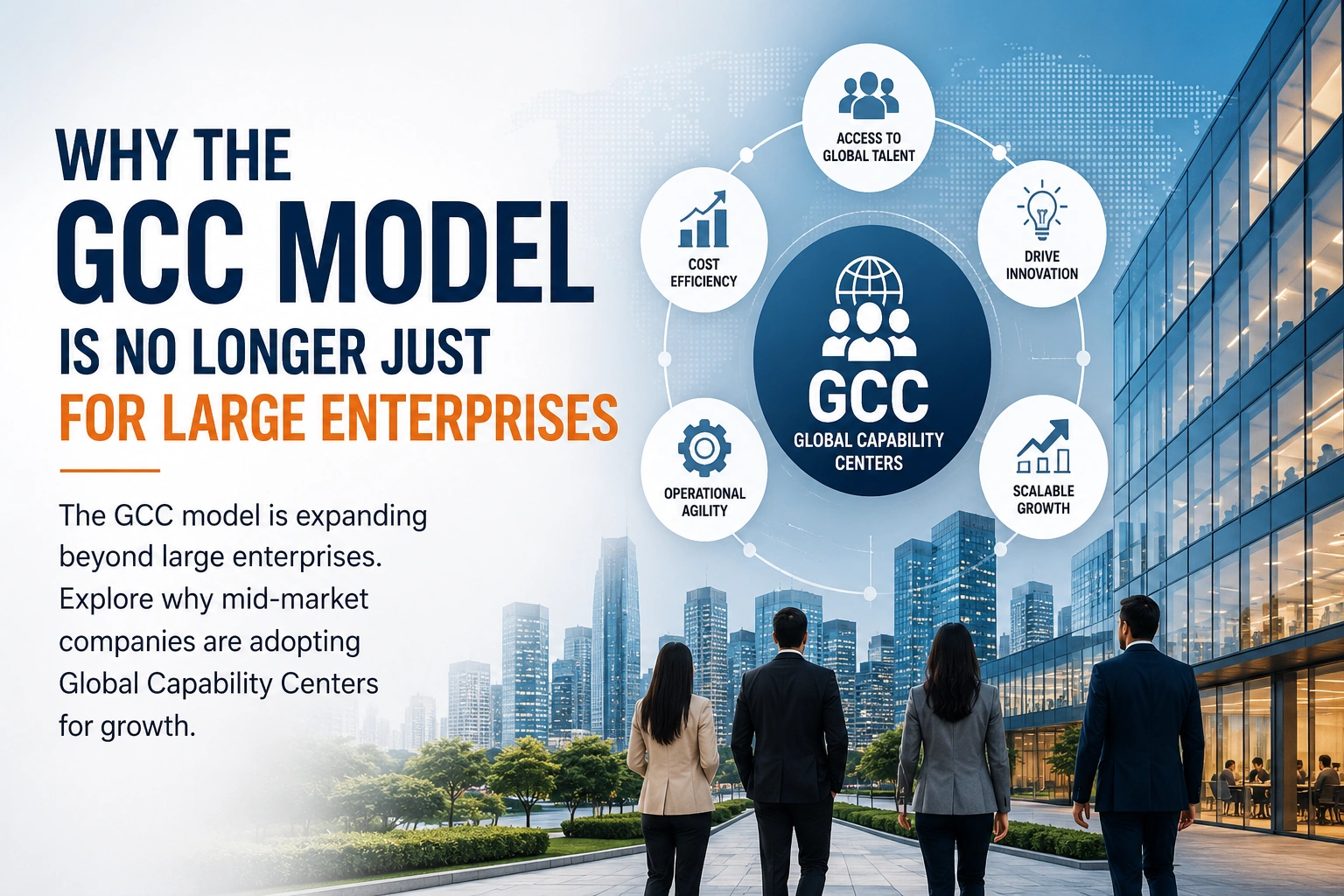
For years, Global Capability Centers (GCC) model has been closely associated with the world’s largest multinational corporations. From technology giants to global banks and manufacturing leaders, these organizations have used GCCs to support critical business functions, access specialized talent, and strengthen their global operations.
Because of this, many businesses have viewed the GCC model as something reserved for enterprises with extensive resources, large teams, and long-term expansion plans.
However, the global business landscape has evolved significantly over the past decade. Advances in technology, changing workforce dynamics, and new approaches to building global operations are reshaping how companies think about capability centers.
Today, an important question is emerging:
Is the GCC model still only for large enterprises, or is it becoming a viable strategy for a broader range of businesses?
In this article, we explore the factors driving this shift, how the GCC model is evolving, and what it means for businesses looking to build long-term capabilities in an increasingly competitive market.
What Is a Global Capability Center?
Before understanding why the GCC model is becoming accessible to a broader range of businesses, it’s important to understand what a Global Capability Center (GCC) actually is.
A Global Capability Center (GCC) is a wholly owned entity established by a multinational company to support and strengthen its global operations. Unlike outsourcing providers, where services are delivered by a third-party organization, a GCC operates as an extension of the parent company, allowing businesses to retain greater control over talent, intellectual property, governance, and strategic business functions.
While GCCs initially focused on operational functions such as IT services, finance, customer support, and human resources, their role has expanded significantly over the years. Today, many GCCs contribute to software engineering, product development, artificial intelligence (AI), research and development (R&D), cybersecurity, analytics, and enterprise-wide digital transformation.
Rather than simply supporting business operations, GCCs have become an integral part of how many multinational companies innovate, develop products, and deliver value across global markets.
Why Were GCCs Traditionally Associated with Large Enterprises?
For decades, establishing a GCC was considered a long-term strategic investment that only large multinational corporations could realistically undertake.
Setting up a traditional GCC often involved significant upfront capital, large-scale hiring, dedicated office infrastructure, regulatory and legal compliance, technology investments, and extensive operational planning. Organizations typically launched these centers with hundreds or, in some cases, thousands of employees while building support functions capable of managing large global teams.
Beyond the financial commitment, businesses also needed the operational maturity to manage distributed teams across multiple geographies, making the model more suited to established global enterprises than growing companies.
As a result, GCCs became closely associated with Fortune 500 companies and other large multinational organizations that had the scale, resources, and long-term business requirements to justify such investments.
However, the business environment has evolved considerably over the past decade. Advances in technology, changing workforce expectations, and a more mature GCC ecosystem have transformed how companies approach global capability building.
The result? The barriers that once limited GCC adoption to the world’s largest enterprises are gradually beginning to come down.
Why the GCC Model Is No Longer Just for Large Enterprises
The growing interest in GCCs among mid-sized enterprises isn’t the result of a single breakthrough. Instead, it’s being driven by a combination of technological advancements, changing business priorities, and a more mature ecosystem that makes establishing and scaling a GCC significantly more achievable than it was a decade ago.
This shift is reflected in the numbers. According to the Nasscom–Zinnov India GCC Report FY2026, India is home to 2,117 GCCs, employing approximately 2.36 million professionals and generating US$98.4 billion in annual revenue. More notably, the report highlights the growing participation of mid-market enterprises, with over 480 mid-market GCCs now operating in the country and accounting for around 35% of new GCC establishments in recent years.
India is also seeing a growing number of mid-market companies set up global capability centers (GCCs), with revenues expected to rise by 15–20% from 2024 to 2026. The adoption of flexible, cost-efficient operating models is fueling this trend, drawing interest from firms across the US, Europe, and the Middle East.
While India represents one of the world’s most mature GCC ecosystems, these developments point to a broader shift in how businesses are approaching global capability building.
So, what’s making this possible?
1. Businesses Are Prioritizing Capability Over Cost
For many years, one of the primary reasons companies established Global Capability Centers was cost optimization. By locating operations in regions with strong talent pools and comparatively lower operating costs, organizations could improve efficiency while supporting their global business functions.
While cost remains an important consideration, it is no longer the defining reason businesses choose the GCC model.
Today, companies are increasingly looking at GCCs as a way to build specialized capabilities that support long-term business growth. Whether it’s developing AI-powered solutions, accelerating product engineering, strengthening cybersecurity, expanding cloud capabilities, or driving digital transformation initiatives, the focus has shifted from where work can be delivered more economically to where strategic expertise can be developed and retained.
This evolution is changing how businesses evaluate the success of a GCC. Instead of measuring its value solely through operational savings, organizations are increasingly assessing how it contributes to innovation, faster product development, improved customer experiences, and stronger competitive advantage.
For growing enterprises, this shift is particularly significant. Companies no longer need to replicate the large, multifunctional GCCs established by global corporations decades ago. Instead, they can begin by building expertise in one or two business-critical areas and expand those capabilities over time as their strategic priorities evolve.
Ultimately, the conversation around GCCs has moved beyond cost arbitrage. Today, it’s about creating sustainable business capabilities that help organizations remain competitive in an increasingly digital and innovation-driven economy.
2. Companies Can Start Small and Scale Strategically
One of the biggest reasons the GCC model is becoming more accessible is that businesses no longer have to build large operations from day one.
Traditionally, companies established GCCs with significant investments in infrastructure, hiring, and operations. Today, many organizations are taking a phased approach, starting with a focused team and expanding as business needs evolve.
This allows companies to test the operating model, build critical capabilities, and scale with greater confidence.
Businesses are increasingly starting with teams focused on:
- Product engineering
- Artificial Intelligence (AI) and data science
- Cloud and digital platforms
- Cybersecurity
- Finance and business analytics
This shift is already visible in the market.
According to the Nasscom–Zinnov India GCC Report FY2026:
- 480+ mid-market GCCs are currently operating in India.
- They employ more than 210,000 professionals.
- Around 35% of new GCC setups in recent years have come from mid-market enterprises.
These figures indicate that GCCs are no longer being considered only by the world’s largest corporations. Instead, more growing enterprises are adopting the model by starting with specialized capabilities and expanding over time.
3. A More Mature GCC Ecosystem Has Lowered Entry Barriers
Setting up a GCC today is very different from what it was a decade ago.
Earlier, companies had to manage almost every aspect of the setup process themselves, from hiring talent and establishing legal entities to securing office space and building operational processes.
Today, businesses have access to a well-established GCC ecosystem that helps simplify and accelerate the journey.
This ecosystem includes:
- GCC consulting and advisory firms
- Build-Operate-Transfer (BOT) partners
- Recruitment and talent acquisition specialists
- Legal, compliance and payroll providers
- Technology and cloud partners
- Managed workspace providers
Rather than building every capability internally from day one, companies can leverage specialized partners to establish operations more efficiently and focus on what matters most: their core business.
The maturity of this ecosystem is one of the reasons more enterprises are exploring the GCC model today. By reducing operational complexity and setup timelines, businesses can adopt a more phased and scalable approach to building global capabilities.
4. AI and Cloud Technologies Are Enabling Leaner GCC Operations
Technology has significantly changed how Global Capability Centers are built and managed.
Cloud computing has reduced the need for businesses to invest heavily in on-premises infrastructure, while AI-powered tools are helping teams automate repetitive tasks, improve productivity, and collaborate more effectively across geographies.
As a result, companies can establish focused teams that deliver high-value work without replicating the large operational models of the past.
Today, GCCs are increasingly supporting functions such as:
- AI and machine learning
- Software and product engineering
- Cloud operations
- Data analytics
- Cybersecurity
This shift is reflected across the industry. According to the Nasscom–Zinnov India GCC Report FY2026, AI has become one of the fastest-growing capability areas within GCCs, with enterprises increasingly expanding AI engineering, data, and digital transformation functions as part of their global operations.
Rather than replacing people, these technologies are helping businesses build more agile and scalable capability centers, making the GCC model increasingly practical for companies that want to grow strategically.
5. Access to Specialized Talent Is Driving GCC Expansion
While cost efficiency remains a consideration, access to skilled talent has become one of the biggest reasons companies establish Global Capability Centers.
As businesses accelerate investments in AI, cloud computing, cybersecurity, product engineering, and digital transformation, the demand for specialized expertise continues to grow. Rather than relying solely on external service providers, many organizations are building in-house teams through GCCs to develop these capabilities over the long term.
Today, companies are looking for talent in areas such as:
- Artificial Intelligence and Machine Learning
- Cloud and DevOps
- Cybersecurity
- Product engineering
- Data science and analytics
This trend is reflected in the scale of global participation. According to the Nasscom–Zinnov India GCC Report FY2026, more than 500 Forbes Global 2000 companies operate GCCs in India, leveraging its deep talent ecosystem and engineering capabilities.
For growing enterprises, this represents an important shift. The decision to establish a GCC is increasingly driven by the need to build and retain specialized capabilities that support future business growth and not just to expand operational capacity.
6. Flexible Operating Models Are Supporting Faster GCC Expansion
The way companies establish GCCs is also evolving.
Earlier, setting up a GCC often meant securing long-term office space, completing infrastructure fit-outs, and investing heavily before operations could begin. Today, businesses have greater flexibility in how they enter new markets and scale their teams.
Many organizations now adopt a phased approach, allowing them to establish operations faster while expanding their footprint as business needs grow.
This flexibility is supported by:
- Managed workspaces and flexible office solutions
- Cloud-first IT infrastructure
- Digital collaboration tools
- Scalable hiring and operating models
Rather than committing to a large office from the outset, companies can align their workspace strategy with their hiring plans and business objectives.
This approach is particularly valuable for growing enterprises that want to establish a presence in a new market, build specialized teams, and retain the flexibility to scale over time.
As the GCC model continues to evolve, the focus is no longer just on where companies operate; it’s also on how efficiently they can establish, grow, and adapt those operations.
Does Every Business Need a GCC?
Not necessarily.
While the GCC model has become more accessible, it isn’t the right fit for every organization. The decision should be guided by long-term business objectives rather than industry trends.
A GCC may be a strong fit for businesses that want to:
- Build long-term engineering or technology capabilities
- Strengthen AI, cloud, or cybersecurity expertise
- Own intellectual property and product development
- Support global operations through dedicated in-house teams
- Scale capabilities over the long term
On the other hand, businesses with short-term projects, limited international operations, or temporary resource requirements may find outsourcing or project-based partnerships more suitable.
The key question isn’t “Is my company big enough to build a GCC?”
It’s “Will a GCC help us build the capabilities our business needs for long-term growth?”
As the barriers to entry continue to evolve, more organizations can now evaluate the GCC model based on strategic fit rather than company size alone.
How EFC Sees the Next Phase of GCC Growth
The evolution of the GCC model isn’t just changing how companies build global teams; it’s also changing how they establish a presence in new markets.
At EFC, we see businesses looking for more than just office space. They are looking for environments that enable them to establish operations quickly, access strong talent ecosystems, and scale efficiently as their business grows.
As more organizations adopt a phased approach to building GCCs, workplace strategy is becoming an integral part of expansion planning. The ability to move into operationally ready workspaces without significant upfront infrastructure investments allows companies to focus on building capabilities while retaining the flexibility to expand when the time is right.
For businesses evaluating the GCC model, the workplace is no longer just a physical location. It’s part of the broader strategy that supports speed, scalability, and long-term business growth.
Conclusion
The perception that Global Capability Centers are only for large multinational corporations is gradually changing.
Advancements in technology, access to specialized talent, a mature GCC ecosystem, and more flexible operating models have made it possible for a broader range of enterprises to explore the GCC model with greater confidence.
That doesn’t mean every business should establish a GCC. However, it does mean that companies no longer need to view GCCs as an option reserved exclusively for the world’s largest organizations.
For businesses focused on innovation, digital transformation, product development, and long-term capability building, GCCs are increasingly becoming a strategic growth model rather than simply an operational one.
As enterprises continue to expand globally and invest in specialized capabilities, the question is shifting from who can build a GCC to how businesses can build one that aligns with their long-term strategy.
FAQs
1. Can mid-sized companies establish a Global Capability Center (GCC)?
Yes, provided the business has a clear long-term strategy for building in-house capabilities. While GCCs were traditionally associated with large multinational corporations, advances in technology, flexible operating models, and a mature GCC ecosystem have made them more accessible to a broader range of enterprises.
2. How is a GCC different from outsourcing?
A GCC is a wholly owned entity of the parent company, giving the business direct control over talent, operations, intellectual property, and strategic functions. In contrast, outsourcing involves contracting a third-party provider to deliver specific services or business processes.
3. What business functions are commonly managed through a GCC?
Modern GCCs support a wide range of functions, including software engineering, product development, artificial intelligence (AI), cybersecurity, cloud operations, finance, human resources, analytics, research and development (R&D), and digital transformation initiatives.
4. What are the key factors businesses should consider before setting up a GCC?
Businesses should evaluate whether a GCC aligns with their long-term goals, the availability of specialized talent, regulatory and compliance requirements, operating costs, leadership readiness, technology infrastructure, and the ability to scale operations over time.
5. Is a GCC suitable for every business?
No. A GCC is most beneficial for organizations looking to build long-term strategic capabilities and retain greater control over critical business functions. Companies with short-term or project-based requirements may find outsourcing or managed services to be a more suitable approach.
Sources:
https://zinnov.com/centers-of-excellence/zinnov-nasscom-india-gcc-landscape-2026-report/