
AI in the Workplace: The Gap Between Readiness and Leadership Is Costing You
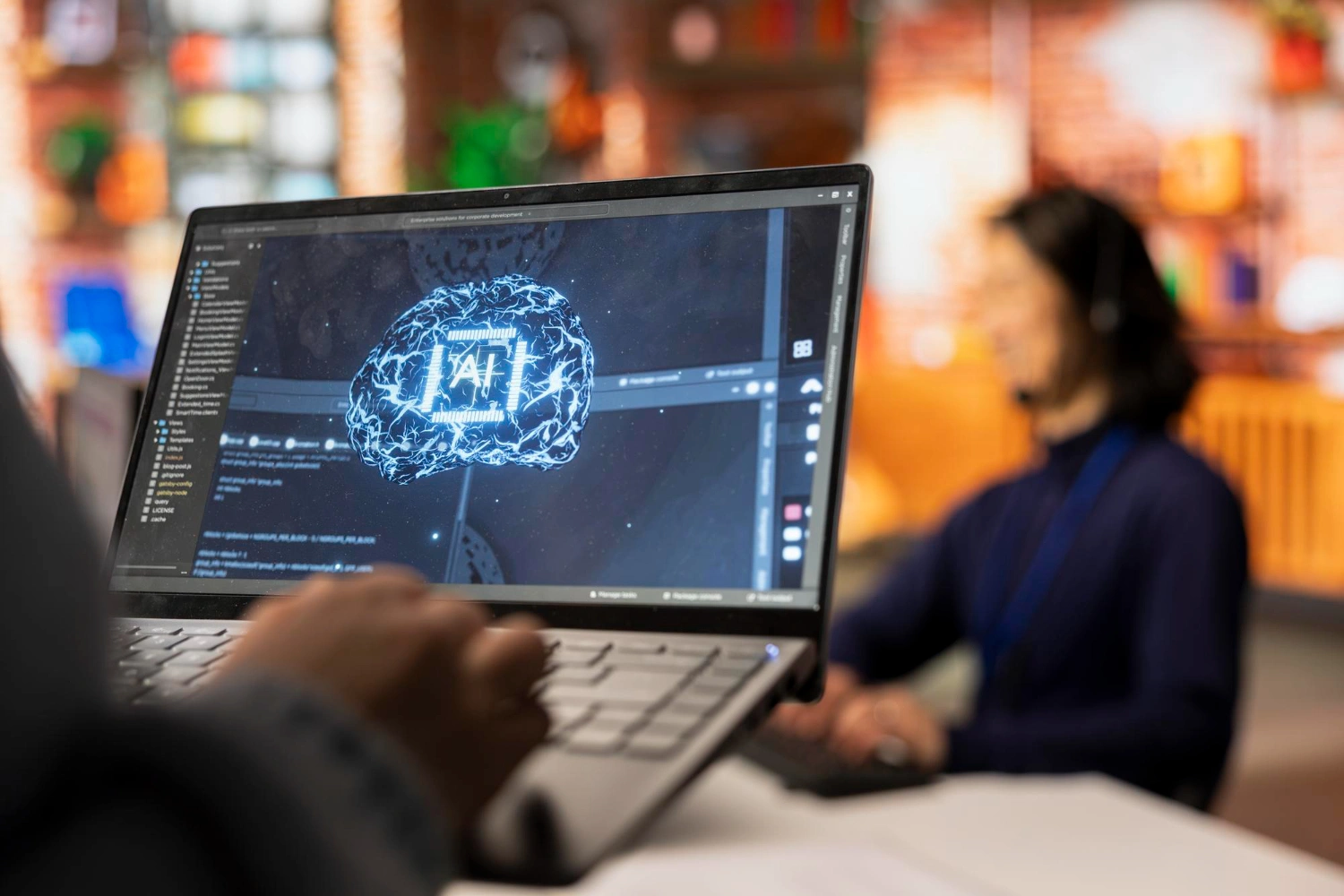
The conversation around AI in the workplace has shifted quietly, decisively, and faster than most organisations have been willing to acknowledge. AI in the workplace is no longer a subject confined to technology conferences or innovation labs. It is happening right now, at individual desks, on laptops, in the in-between moments of the workday. It is where an analyst summarises a 40-page report in four minutes, where a sales manager drafts three client proposals before noon, and where a mid-level executive walks into a meeting having already processed data that would have taken a team two days to compile.
This is what the AI workplace actually looks like today. Not a pilot programme. Not a proof of concept. Not a slide in a strategy deck. It is already woven into how millions of people work, quietly, incrementally, and largely without any formal direction from the top.
Employees have found AI. They are using it. And in most organisations, leadership has not fully caught up with what that means.
This is not a technology story. It was never a technology story. It is a leadership story, and for businesses across India and the world, the gap between where employees already are and where leadership is willing to go is becoming one of the most consequential fault lines of the modern workplace.
The Scale of What Is Actually Happening
Earlier this year, McKinsey released a landmark study, Superagency in the Workplace, based on conversations with over 3,600 employees and 238 C-suite executives across industries and geographies. The findings were striking, not because they revealed something entirely unexpected, but because they put hard numbers to something many in the workplace industry have been sensing for a while.
Almost every major company in the world has invested in AI in some form. Yet only 1% believe they have reached any meaningful level of maturity in how they use it. That gap between investment and impact, between adoption and transformation, is the central challenge of this moment.
To understand the scale of what is at stake, it helps to reach for historical context. The steam engine did not simply make factories faster. It reorganised the entire logic of how economies worked, where people lived, and what kinds of work had value. The internet did not simply make communication cheaper. It created entirely new industries, eliminated others, and fundamentally altered what it meant to be competitive in business. AI in the workplace is being placed in that same category and not by technology enthusiasts looking for the next big thing, but by serious economists, business researchers, and now, by the data coming out of organisations themselves.
The question is not whether AI will reshape the modern workplace. That is already underway. The question is who will be positioned to lead that reshaping and who will spend the next several years catching up.
The Perception Gap That Nobody Is Talking About
One of the most revealing findings from the McKinsey research is what might be called the perception gap, a significant disconnect between what C-suite leaders believe is happening inside their organisations and what is actually happening on the ground.
When senior executives were asked to estimate what percentage of their employees use AI for at least 30% of their daily work, the average answer was around 4%. The actual figure, as self-reported by employees, was closer to 13%, more than three times higher.
This is not a small rounding error. This is a structural blind spot.
Leaders are making decisions about AI investment, training, rollout timelines, and strategic priorities based on a picture of employee behaviour that is significantly out of date. Meanwhile, employees often without formal training, without official tools, sometimes even without explicit permission, have gone ahead and integrated intelligence into their workplace routines because it simply makes their work better. They are not waiting for a policy document. They are not waiting for a sanctioned tool. They are moving because the results speak for themselves.
The implications of this gap are serious. Organisations where leadership underestimates employee readiness tend to under-invest in training, delay tool deployment, and create informal cultures where AI use is neither supported nor governed. Employees end up using personal accounts on public AI tools, sharing company data without enterprise-grade security, and developing habits and workflows that are completely invisible to the organisation. That is not a recipe for transformation. That is a recipe for risk.
Employees Are Further Along Than the Narrative Suggests
The dominant storyline around AI and the workforce has been one of anxiety. Jobs at risk, skills becoming obsolete, and workers resistant to change. That narrative, while not entirely without basis, is increasingly at odds with what the data actually shows.
Employees, by and large, are not afraid of AI in the workplace. They are using it. They are curious about it. And significantly, they want more support with it, not less exposure to it.
Nearly half of the employees surveyed in the McKinsey study said they want more formal training in AI. More than a fifth reported receiving minimal to no support from their organisations in this area. The demand for guidance is there. The supply from leadership is lagging.
There is also a fascinating generational finding that challenges conventional assumptions. It is widely assumed that the youngest workers, Gen Z, digital natives who grew up with smartphones and social media, would be the most proficient with artificial intelligence at workplace. The data suggests otherwise. Employees between the ages of 35 and 44, largely Millennials who built their careers through the entire arc of the internet age, report significantly higher levels of AI expertise than their younger colleagues. 62% of this group describe themselves as highly proficient, compared to 50% of the 18–24 age group.
This matters enormously for how organisations think about AI strategy. The instinct is often to look toward the youngest employees as the drivers of technology adoption. But the most effective AI champions inside organisations are likely to be experienced professionals who understand both the technology and the business deeply enough to apply it meaningfully. These are the people who can connect AI capability to real business problems and not just use it for convenience.
For the Indian workplace in particular, where a large and highly educated Millennial workforce sits at the heart of most growing organisations, this finding has direct strategic significance. The talent to lead AI adoption from within already exists. The question is whether leadership is creating the conditions for that talent to do so.
The Leadership Problem at the Centre of It All
If employees are ready, if the technology is available, if the business case is understood, then what exactly is holding organisations back?
The McKinsey findings point clearly to leadership as the critical variable. Not leadership in the sense of vision or intent, but most senior leaders will readily articulate why AI matters and where they want their organisations to go. The gap is in the translation of that intent into action. In the willingness to make decisions under uncertainty, to invest ahead of proven returns, to move at the pace the technology demands rather than the pace that feels comfortable.
47% of C-suite leaders in the study acknowledged that their organisations are developing and releasing AI tools too slowly. This is a remarkable admission that leaders recognise in real time that they are the constraint in their own transformation agenda.
The reasons are understandable. AI investment has not yet produced the revenue results that justify the hype in most organisations. Only 19% of executives report revenue increases of more than 5% attributable to AI. Boards want to see returns before approving further investment. Legal and compliance teams raise legitimate concerns about governance. The tools are evolving faster than procurement cycles. All of this is real.
But here is the counter-argument that the data supports: the organisations that will see strong AI-driven revenue growth in the next three years, and 87% of executives believe that growth is coming, are almost certainly the ones that are making the hard calls today. Competitive advantage in technology adoption has never come from waiting until the path is completely clear. It has always come from moving with conviction while others are still deliberating.
What This Means for the Indian Workplace
India’s workplace is at a genuinely interesting inflection point. The managed office sector has grown significantly over the last decade, driven by companies seeking flexibility, infrastructure quality, and environments that can support a more dynamic, distributed workforce. Hybrid work has become a permanent feature of how businesses operate, not a temporary response to circumstance.
Into this context, AI arrives not as a distant future consideration but as an immediate operational reality. Indian businesses are not observing the AI workplace transformation from the sidelines; they are participating in it. The same dynamics playing out in global research are visible here: employees exploring tools on their own, organisations uncertain about governance, leadership aware of the imperative but uncertain about the pace.
What India’s workplace ecosystem has, however, is a structural advantage that should not be underestimated. A large, young, highly educated workforce with strong digital fluency. A business culture that has demonstrated, repeatedly, the ability to adapt rapidly to technological change. A growing cohort of organisations across sectors that are thinking seriously about what it means to build a modern workplace fit for the next decade, not just the last one.
The future of workspace in India will not be defined by square footage or location alone. It will be defined by how intelligently work gets done within it, and that is a question AI is already beginning to answer, with or without leadership’s permission.
The organisations that move with clarity and ambition on AI right now are not simply adopting a new tool. They are defining what kind of company they intend to be in a landscape that will look very different five years from now.
The Window Is Narrower Than It Appears
One of the most important lessons from previous technology transitions is that the window for establishing competitive advantage is shorter than it feels while it is open. During the early years of internet adoption, it was easy to rationalise waiting; the tools were imperfect, the business models unproven, the risks real. The organisations that moved anyway built positions that became extraordinarily difficult to displace. The ones that waited found themselves restructuring, acquiring, and scrambling to close gaps that had become structural.
AI is moving faster than the internet did. The gap between early movers and late movers will likely close faster, too, but the penalties for being on the wrong side of that gap will be just as significant.
The encouraging finding in all of this is that the foundation for action already exists inside most organisations. Employees are ready and willing. Trust in leadership, at 71% among the employees surveyed, is high. The cultural resistance that might have made this transition harder is, by the data, not the primary obstacle.
What is required now is not more research, more pilots, or more strategy documents. What is required is the willingness to lead, to make decisions, to invest in people, to build the governance structures that allow AI to be used well, and to move at a pace that matches the scale of the opportunity.
Three Things That Separate Leaders From Laggards
Across organisations that are beginning to close the gap between AI investment and AI impact, a few patterns emerge consistently.
Investing in people before tools.
The instinct is to purchase technology and then figure out adoption. The more effective sequence is to build capability first, structured training, internal champions, clear guidance on what good AI use looks like, and then deploy tools into a workforce that is prepared to use them well.
Closing the perception gap deliberately.
Leaders who are operating with inaccurate assumptions about employee AI usage need better information. This means creating channels, surveys, working groups, and direct conversations through which the actual state of AI adoption inside the organisation becomes visible. Decisions made on accurate data are almost always better than decisions made on comfortable assumptions.
Treating AI governance as an enabler, not a brake.
Many organisations have allowed compliance and legal concerns to become reasons for inaction rather than frameworks for responsible action. The organisations moving fastest are not ignoring governance; they are building it in parallel with deployment, creating clear policies that allow employees to use AI confidently rather than furtively.
The Workplace Is Being Redefined
The workplace has always been more than a physical location or an organisational chart. It is the physical, cultural, and technological environment in which people do their best work. Every major technology transition has reshaped that environment, and every time, the organisations that understood the transition as a human challenge as much as a technical one were better positioned to navigate it.
AI in the workplace is no different. The technology is capable. The people, largely, are willing. The transformation that is possible in productivity, in the quality of work, in what organisations can accomplish, is genuine and significant.
What determines whether that transformation actually happens is not the AI. It is the leadership. It is the willingness to close the gap between knowing that something important is underway and acting with the ambition the moment deserves.
At EFC, we work with organisations at the intersection of physical workspace and the evolving nature of work itself. What we observe, consistently, is that the companies shaping the future of workspace are not waiting for certainty. They are building with clarity of direction, about the kind of organisation they want to be, the kind of environment that brings out the best in their people, and the kind of leadership that earns the trust that, by the data, employees are already extending.
The gap is real. The cost of leaving it open is growing. The path forward, however, is clearer than it might seem.
FAQs
- Is AI in the workplace just a trend or is it here to stay?
It is here to stay. Just as the internet permanently changed how businesses operate, AI is fundamentally changing how work gets done. The organisations treating it as a passing trend are the ones most at risk of falling behind.
- How is AI in the workplace different from regular software or automation tools companies already use?
Traditional software follows fixed rules and performs exactly as it is programmed. AI learns, adapts, and can handle tasks that require judgment, language, and context. That is what makes it a fundamentally different shift and not just another upgrade.
- Does adopting artificial intelligence at the workplace require a huge budget?
Not necessarily. Many AI tools are affordable, and some are free to start. The bigger investment is in training people and building the right culture around it. Companies that start small, learn fast, and scale gradually see better returns than those waiting for a large budget-approved plan.
- How do employees feel about working alongside AI in the modern workplace?
More positively than most leaders assume. Research shows the majority of employees trust their organisations to use AI responsibly and are actively asking for more training. Resistance is far less common than leadership fears.
- How long does it realistically take for a company to see results from AI in the workplace?
It varies, but companies that go beyond experimentation and embed AI into core workflows typically begin seeing meaningful impact within 12 to 18 months. The ones stuck in pilot mode indefinitely rarely see returns regardless of how much they spend.
Source: