
Hybrid Work Office Space in India: What Occupiers Want in 2026
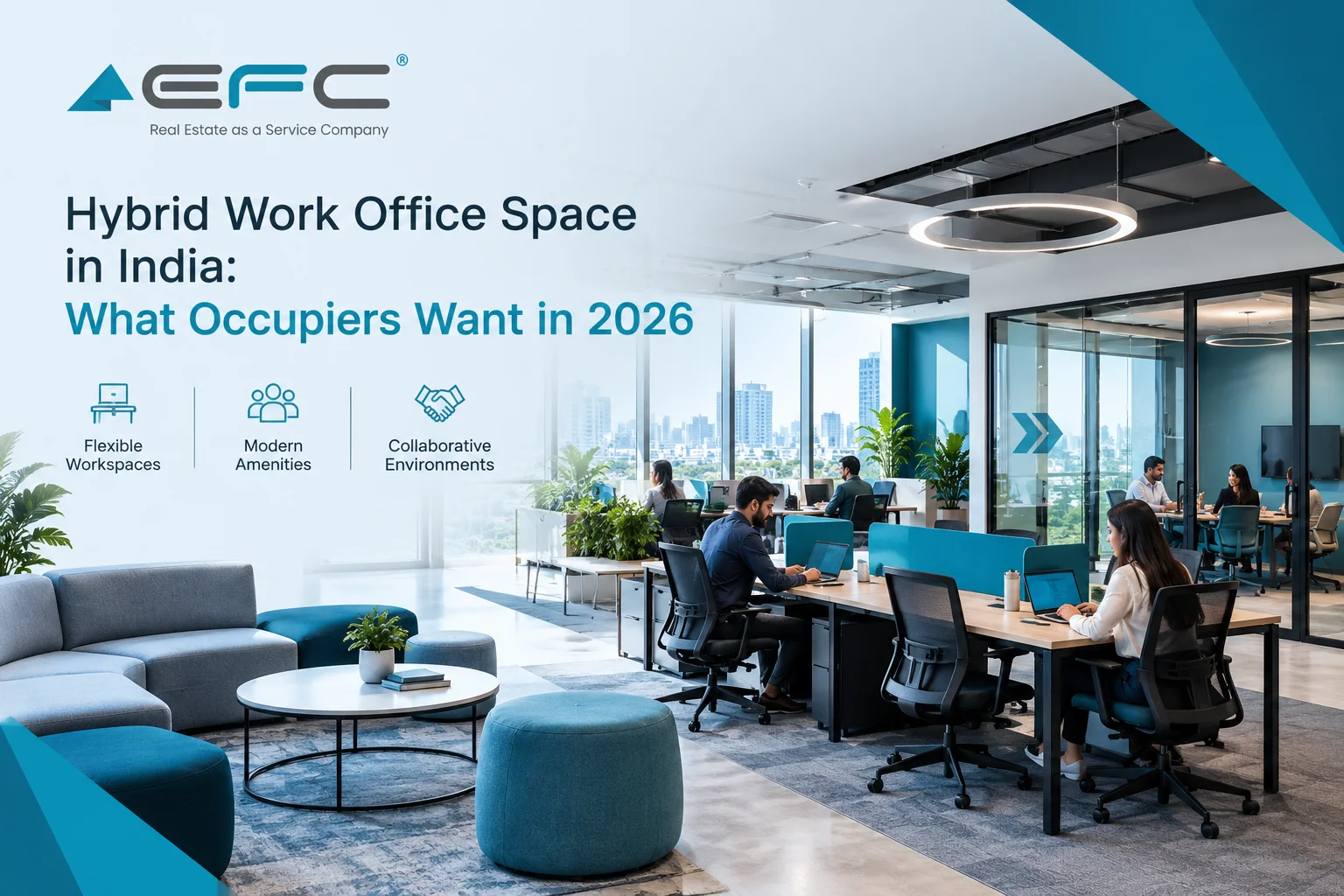
Hybrid work office space in India is no longer a policy debate. It is a leasing strategy. Occupiers are cutting desk ratios, shortening commitments and spreading teams across hub and spoke networks, and flex operators are absorbing the shift at record pace. Here is what that means for space size, lease length and format.
Hybrid Is the Baseline
Hybrid has moved from pilot to standard. 73% of occupiers point to hybrid adoption as a force sustaining demand for flexible leases. The leasing data backs it up: flex operators leased 191,306 seats across India’s top eight cities in H1 2026, a 68.4% rise on the year before.
| Metric | Data Point |
| Flex share of H1 2026 leasing, top seven cities (JLL) | 27.0%, with flex leasing a record 10.23 mn sq ft |
| Global Capability Centre (GCC) share of flex seats, H1 2026 | 44%, up from 37% in 2025 |
| Flex share of new office leasing, 2024 | 15% |
| Flex stock projected by end of 2026 | Above 100 million sq ft |
Space Size: Fewer Desks, Tighter Utilisation
Hybrid attendance rarely fills every desk at once, so the 1:1 desk is the first assumption to go. On global hybrid benchmarks, most hybrid enterprises see peak utilisation of 40% to 60%, with desk-to-employee ratios moving from 1:1 to between 0.6:1 and 0.8:1. The same guide, published by a flex operator, estimates an optimised hybrid footprint costs 25% to 40% less than a full-occupancy office.
Office seat utilisation in India is the first number to measure. Track three:
- Peak utilisation: pull 90 days of badge, desk-booking or sensor data, split by floor, team and weekday.
- Co-attendance rate: how often a team’s in-office days actually overlap.
- Cost per occupied desk: the real efficiency metric, tracked monthly.
Right-Sizing Is Not Retreating
Smaller footprints per head do not mean less demand for space. JLL reports that global-headquartered firms, which took 55.2% of India office leasing in H1 2026, are right-sizing portfolios and headcount projections while staying invested in India. The market is tightening around them. Vacancy across the top seven cities fell to 14.5%, a five-year low, as H1 net absorption reached a record 26.9 mn sq ft. JLL also flags pressure on existing portfolios as occupancy builds.
The implication for hybrid occupiers: with vacancy at a five-year low, cutting desks without securing flexible overflow capacity is a risk, not a saving.
Lease Length: Commitment Is Shrinking
Fixed, long leases are hard to justify when attendance is variable. Indian flex demand has grown close to six times since 2020, as occupiers favour shorter commitments, managed solutions and faster move-ins. Flex is now a mainstream tool, not a stopgap: more than half of occupier executives use it to control costs and support hybrid work.
The shift is from owning capacity for peak days to renting capacity for actual use. A hybrid workplace strategy in India now starts with commitment length, not floor area.
The Hub and Spoke Office Model India Is Adopting
Employees are pushing in the same direction. 74% of users want distributed workplaces, while 53% of employers now favour hybrid policies. Enterprises are answering with one anchor office (the hub) plus smaller nodes near talent (the spokes).
An operator guide citing the CBRE-FICCI Flex-plosion report of March 2026 treats the Hub and Spoke office model as a core pattern in how enterprises adopt flex in India.
A Bengaluru broker reports the typical split: about 40% of a company’s workforce stays at the hub, and 60% is spread across three to four spokes.
| Node | Typical Format | Seats | Commitment |
| Hub | Managed office | 100 to 2,000 | 12 to 36 months |
| Spoke (secondary city) | Managed office or large coworking | 20 to 200 | 6 to 18 months |
| Occasional use | Hot desk or day pass | Variable | Monthly rolling or same day |
Hybrid Readiness Checklist for Occupiers
Before resizing, work through six steps:
- Run the utilisation audit. Use the three metrics above, by floor, team and weekday.
- Map your lease events. List expiry dates, break clauses and cost per sq ft for every location.
- Ask employees. Survey preferred work patterns, commute constraints and collaboration needs.
- Size the anchor office to peak-day attendance (the most people in the office on your busiest day), not total headcount.
- Place spokes where talent and clients are, and match format to spoke size.
- Match commitment to certainty. Longer terms for the anchor, shorter terms for teams still validating a location.
EFC Limited’s Perspective: Built for Hybrid Teams
Hybrid work breaks the traditional lease. You pay for a desk for every employee, but your whole team is rarely in the office on the same day.
EFC Limited’s view: plan your main office around the number of people who actually come in on your busiest day, and use flexible space for everyone else.
EFC Limited offers Managed Offices, Enterprise Offices, Service Suites and Coworking. A company can use one format for its main team and another for smaller or temporary teams, all with one provider. That is flexible office space for hybrid teams, with one provider instead of one per location.
EFC Limited operates across Pune, Mumbai, Hyderabad, Chennai, Kolkata, Ahmedabad and Delhi NCR (Delhi, Gurugram and Noida). In Mumbai, its centres include Parinee Crescenzo in Bandra Kurla Complex and Empire Tower in Airoli.
A company can base its main team in one city and place a second team in another, or pair an established business district with a lower-cost area, all with one provider.
Conclusion
Hybrid has changed three decisions at once: how many desks, how long the lease runs and where teams sit. Occupiers who measure utilisation first, shorten commitments and match format to role will carry less idle space. For managed office providers, the brief is clear: build for peak-day demand and flexible access, not for headcount.
Frequently Asked Questions
- How is hybrid work changing office space demand in India?
Hybrid work is cutting desk-to-employee ratios, shortening lease commitments and pushing occupiers towards managed and flexible formats. Demand is shifting from owning peak-day capacity to renting space that matches actual attendance. - What is the hub and spoke office model?
It pairs one anchor office, the hub, with smaller offices, the spokes, placed near talent or clients. The hub hosts collaboration days; spokes, often coworking or managed offices, cut commutes for hybrid employees. - Which format suits hybrid teams: coworking or managed office?
Coworking suits small spokes of under about 20 people and occasional office days. Managed offices suit larger teams that need dedicated space and operational structure, such as an anchor hub or a spoke above that size. - What is office seat utilisation and why does it matter in India?
It measures how many available desks are actually occupied on a typical day. For hybrid teams, tracking it by day of the week shows true peak demand and prevents paying for desks that sit empty most of the week. - Does EFC Limited offer flexible office space for hybrid teams?
Yes. EFC Limited offers Managed Offices, Enterprise Offices, Service Suites and Coworking across cities including Pune, Mumbai, Hyderabad, Chennai, Kolkata, Ahmedabad and Delhi NCR, so hybrid teams can match format to how often they use the office.
References
- BW Businessworld: India Flex Office Leasing
- The Hans India: Hyderabad Fuels India’s Flexible Workspace Boom
- Cushman & Wakefield: India Emerges as a Global Leader in Flexible Office Market
- Mordor Intelligence: India Coworking Office Spaces Market Size
- Upflex: Hybrid Work Office Space: A Complete 2026 Guide
- Qdesq: What is the Hub and Spoke Office Model?
- JLL India: India Office Market Dynamics Q2 2026